Blog
4 MINS
Lean management, startup mindset, agile methods, creativity workshops…
If you still had any doubts that innovation is a top priority for companies, these numerous techniques, strategies, and methodologies should put them to rest. While innovation seems to be everywhere—at least on the surface—it is not always developed or promoted with the effectiveness it deserves. Innovation inevitably requires time, resources, and a structured organization that must be clearly defined.
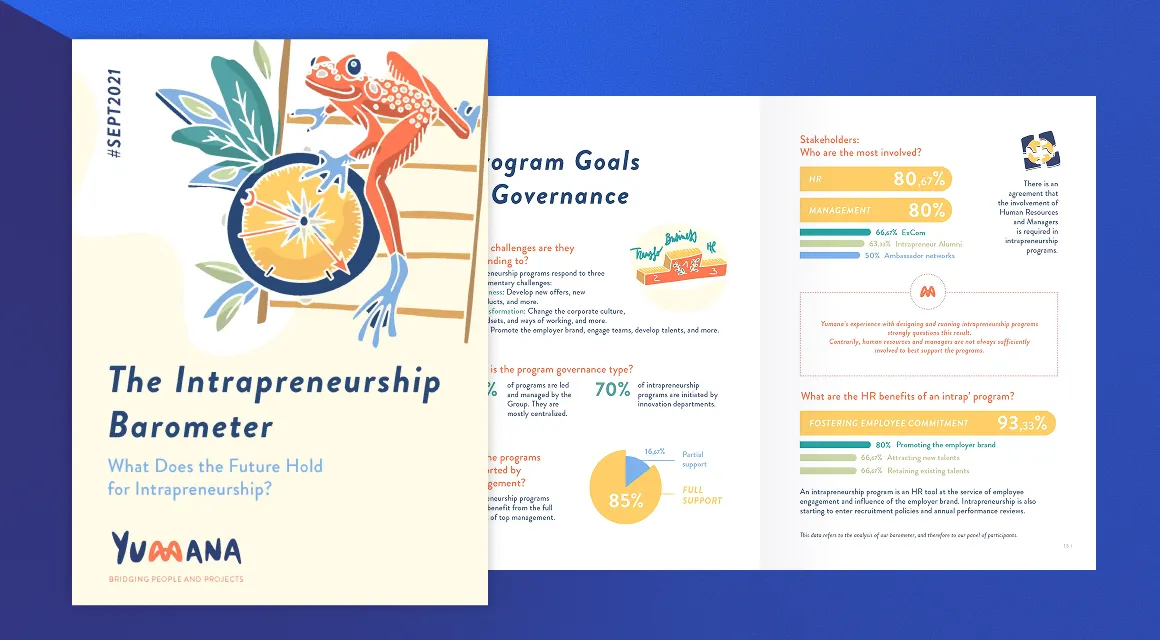
Among the best practices that continue to set the standard, intrapreneurship remains a safe bet. On the one hand, it is a model that has existed for more than 50 years, free from communication gimmicks, fleeting trends, and passing fashions. On the other hand, it can be implemented by any organization, regardless of size or industry.
Curious to learn more about tomorrow’s innovation model?

A participative model
Intrapreneurship is the result of collaborative work. Before an idea becomes a project, all employees can contribute, share, and enrich existing contributions. This participative approach is essential in an intrapreneurial initiative, as it exposes ideas to multiple perspectives across the organization. Employees often view challenges through the lens of their daily operational constraints. By mixing and confronting expertise and viewpoints, companies can overcome the filtering effect that stifles many innovative projects. While some may say, “This will never work—we’ve already tried,” others will respond, “It’s a great idea, and I want to help.”
An inclusive model
Intrapreneurship can be seen as entrepreneurship within a company. And just like entrepreneurship, it does not require a degree, prior experience, or formal legitimacy tied to a job title. What holds true for entrepreneurship also applies to intrapreneurship. It is an inclusive model where everyone can share ideas and comment on others’. From sales assistants to finance managers, from quality engineers to front-desk staff, all employees are encouraged to participate—and perhaps even to found their own internal startup.
An innovative model
Through the lens of collaborative innovation, intrapreneurship is a powerful lever for generating new ideas. By encouraging employees to think differently, step outside their comfort zones, and challenge long-standing habits and internal processes, organizations can spark true innovation. Intrapreneurship is innovative by nature. Innovation also lies in the ability to identify and connect intrapreneurial profiles, which are often difficult to spot. Being an intrapreneur does not always align with traditional corporate norms. By creating the right context and culture, intrapreneurship helps unlock voices and ideas that might otherwise remain unheard.

A high value-added model
To launch an intrapreneurship program, a company must be ready—ready to take risks, accept failure, temporarily remove talent from day-to-day operations, and ultimately question itself while encouraging experimentation. Behind intrapreneurship lie many innovative projects that have emerged within organizations in recent years. It is a high value-added model that may require transforming a business model, creating a new product line, or even inventing tomorrow’s business—one that disrupts today’s organization in order to help it grow.
A model that must be structured
As appealing as it may be, implementing an intrapreneurship strategy cannot be improvised. Support from top management as well as middle management (business units, R&D, functional teams, etc.) is essential. At a minimum, the goal is to ensure that no obstacles stand in the way of projects. Ideally, organizations will promote cross-functional synergies, collaboration, and cross-fertilization.
Successful intrapreneurship also requires an ideation platform capable of collecting ideas, scoring them, and integrating them into an advanced gamification process to encourage participation. Clear rules around project organization, a jury, ambassadors, coaches, and a modest operating budget are also necessary. With these simple resources, an idea can become a project—and a project can turn into an actionable business opportunity.
Thanks to its simplicity and remarkable effectiveness, intrapreneurship stands as the ultimate innovation model. By focusing on high-potential, disruptive projects, it offers growing development opportunities. Investing in intrapreneurship today is an insurance policy for tomorrow’s success.
CEO & Co-Founder