Blog
Artificial intelligence is already transforming how innovation teams work, yet its impact on project progress remains more limited. This gap raises a governance question: do innovation leaders have the mandate and flexibility to direct productivity gains toward the stages that truly drive value creation?
In just a few years, artificial intelligence has become part of innovation teams’ everyday work. Researching information, analyzing trends, summarizing documents, generating ideas, and preparing presentations: activities that once took considerable time can now be completed much faster.
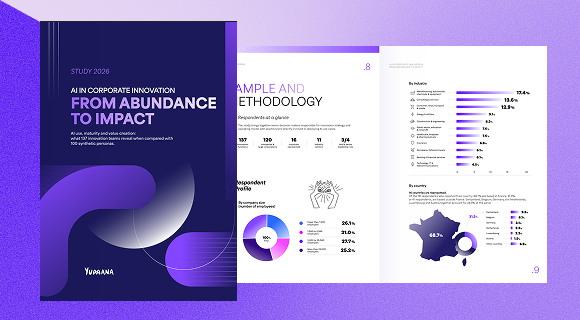
For its 2026 study, AI in Corporate Innovation: From Abundance to Impact, Yumana surveyed 137 innovation professionals from 120 companies and large corporations across 16 countries.
Of those surveyed, 82% say AI saves them time, and 39.5% say they explore more ideas. Yet only 4.4% report improvements in moving from prototype to deployment, while just 8.8% see an improvement in the business impact of their project portfolios.
Innovation cycles are often long, which may partly explain the gap between productivity gains and their impact on projects. Yumana’s study highlights the time savings reported by teams, but how that time is used remains an open question.
So what actually happens to that time? Do teams spend it strengthening business cases, testing market assumptions, engaging business units, or preparing to scale? Or does this additional capacity lead to more ideas, analyses, and reviews—or simply get absorbed by new requests?
Our hypothesis is that these different outcomes depend, in part, on how innovation teams are evaluated and how much freedom they have to influence project progress.
When Time Savings Lead to More Work
The assumption that productivity gains automatically free up resources for more strategic activities is based on a rather mechanical view of work.
When a task takes less time, we tend to assume the hours saved can be allocated elsewhere. But within organizations, time is not a reserve that employees can draw on at will.
Preparing a document faster may simply mean producing another one. Faster trend research may encourage teams to explore more topics. Automated portfolio analysis may trigger more requests for further investigation.
Every local improvement creates new possibilities—and potentially new expectations.
What the research shows
This dynamic has been observed beyond innovation functions. In an article published by Harvard Business Review in February 2026, Aruna Ranganathan and Xingqi Maggie Ye present findings from an eight-month study at a US technology company with approximately 200 employees.
Their findings are counterintuitive: AI tools did not simply reduce workloads. They intensified them.
Employees expanded the scope of their responsibilities, worked at a faster pace, and extended certain activities beyond their usual working hours, often without being explicitly asked to do so by management.
AI made more tasks achievable, and employees took it upon themselves to complete them.
This qualitative study, conducted at a single company, does not mean these behaviors can be generalized to every organization.
It does, however, highlight an important distinction between two concepts that are often confused:
This distinction is especially relevant for innovation teams.
Their work is rarely constrained by a lack of potential topics to explore. Quite the opposite: demand can easily exceed available resources, from technological opportunities and business-unit requests to startups to meet, experiments to support, and projects to champion.
In this environment, higher productivity may simply be absorbed by an increase in activity.
What Innovation Leaders are seeing
At a roundtable hosted by Yumana on November 17, 2026, to present its study on AI in Innovation Teams, representatives from several large companies shared their experiences.
Customer insight: Bouygues Telecom
Olivier Levacher, Head of AI Factory at Bouygues Telecom, described this shift: “We’re working on more projects, and we’re inevitably going deeper into our project analyses.”
He explained that his team could now conduct more in-depth analyses that it previously lacked the time or skills to undertake. Here, the time saved increases both the volume and depth of innovation work, without necessarily telling us anything about its impact on deployment.

One finding from Yumana’s study makes this hypothesis particularly interesting: among respondents who report no significant impact of AI on their project portfolios, 92% nevertheless say it saves them time.
Individual efficiency and collective performance can therefore evolve in different ways.
The challenge is whether organizations can turn fragmented time savings, scattered across tasks and employees, into a resource that can be directed toward shared priorities.
When Faster Exploration Puts Pressure on Downstream Stages
Yumana’s study sheds light on where this additional activity is currently concentrated. AI is used primarily in the early stages of the innovation process: 53% of respondents use it to generate ideas, 50% to turn them into concepts, and 44% to analyze trends and weak signals.
At the other end of the process, just 11% use it to optimize solution journeys and adoption.
This distribution partly reflects the technology’s current capabilities. Generative AI models are particularly effective at finding, rephrasing, comparing, and structuring information.
Their contribution becomes more complex when projects depend on investment decisions, physical experiments, industrial constraints, or organizational commitments.
A bottleneck that shifts
In an innovation process, making one stage more productive does not guarantee an equivalent improvement across the entire process.
If teams can assess more opportunities without increasing the organization’s capacity to select, test, or deploy them, the backlog of projects may grow.
Productivity gains may therefore shift the bottleneck rather than remove it.
The Procter & Gamble experiment
An experiment conducted at Procter & Gamble and published in Organization Science in 2026 offers useful insight into this distinction.
Researchers from Harvard Business School, Wharton, ESSEC, and other institutions studied the effects of AI on 791 P&G professionals working on real new-product development challenges.
Participants were randomly assigned to four configurations: individuals or pairs combining R&D and commercial professionals, working either with or without AI.
The findings show that individuals using AI produced work of comparable quality to pairs working without it.
AI also helped bridge functional divides: R&D specialists developed proposals with a stronger commercial perspective, while their commercial counterparts incorporated more technical considerations.
But another finding deserves attention. AI primarily improved the quality of the ideas generated, without producing a comparable improvement in the ability to select the best proposals. Human judgment continued to play an important role in this evaluation stage.
The experiment does not demonstrate that P&G teams reinvested their time savings in deploying innovations. It does, however, show that AI does not benefit every stage of the process equally—and that distinction matters.
Better ideas can increase a portfolio’s potential. But organizations still need the capabilities to test those ideas against market realities, establish their business viability, and mobilize the resources needed to deploy them.
As the cost of research and knowledge work declines, other resources become relatively scarcer: decision-makers’ attention, experts’ availability, time for experimentation, and business units’ capacity to absorb change.
The risk, then, is not simply generating too many ideas. It is devoting an increasing share of people’s time to managing that abundance instead of turning the most promising opportunities into deployed innovations.
2 Ways to Use the Same Additional Capacity
Now imagine two innovation teams achieving similar productivity gains through AI.
These organizations are hypothetical, but they illustrate two plausible approaches to management.
In the first, the team decides to focus some of its newly available capacity on the stages that determine whether projects succeed.
Time previously spent researching information or preparing documents is reinvested in validating critical assumptions, developing stronger business cases, speaking with customers, or anticipating deployment requirements.
Consider a project whose business case rests on several unresolved assumptions: customers’ willingness to pay, the cost of integrating the solution into existing systems, or operational teams’ ability to adopt it.
AI can make it easier to gather data, model scenarios, and prepare analyses. Employees can then spend more time testing those assumptions against real-world evidence, speaking with stakeholders, and securing the necessary commitments.
Reinvesting time in this way could enable teams to test a project’s business assumptions more rigorously, better understand its risks, and make more informed investment decisions.
An innovation team that reinvests its time savings in this way may select fewer projects, but assess them more thoroughly, discontinue those with limited prospects sooner, and better support the others through to deployment.
Customer insight: SOMFY
At SOMFY, time savings support two complementary approaches. During a Track Talk co-hosted with Yumana at the Innovation Roundtable in Copenhagen, Emmanuel Joumard, Innovation Director at SOMFY, explained that his team reinvests part of the time saved in deploying new AI agents to further improve the efficiency of the innovation process.
The rest gives teams more opportunities to discuss ongoing projects and meet customers to better understand their needs and design more relevant solutions. Time is thus reinvested in both tools and the human interactions that improve project relevance.
In the second organization, the additional capacity could produce a very different outcome.
With more powerful analytical tools at their disposal, teams might increase the number of evaluations, dashboards, and requests for justification.
The ability to obtain additional information quickly could lead to more checkpoints and more detailed project oversight.
The mechanism is plausible: when requesting an analysis becomes easier and less costly, the temptation to request more analyses grows.
At first glance, this may look like better governance. Projects are more thoroughly documented, risks are more clearly identified, and decisions are supported by more evidence.
Beyond a certain point, however, multiplying controls risks delivering diminishing returns. Project teams spend more time responding to supervisors’ requests, approval processes become longer, and decision-making responsibility becomes more diffuse.
Paradoxically, AI could end up reinforcing some of the organizational rigidities that innovation teams are trying to overcome.
What respondents’ priorities reveal
Yumana’s study suggests that exploration may continue to dominate innovation teams’ priorities.
Among respondents, 47.3% primarily want to strengthen their ability to identify new use cases and opportunities, compared with 17.9% who want to improve performance and value management. And among the 45 respondents considering delegating certain stages of the process to AI agents, 71% are targeting exploration and technology scouting.
These intentions point to a potential risk: further expanding exploration capacity without a corresponding increase in resources devoted to moving projects forward.
Performance criteria as a lever
Performance criteria are one lever that can shape how productivity gains are reinvested.
An innovation team evaluated primarily on the number of opportunities identified or projects launched may be encouraged to use AI to intensify those activities.
When performance is assessed through the reduction of uncertainty, the quality of decisions, and the adoption of innovations, teams have greater incentives to devote their additional capacity to advancing projects.

Reallocating Time Means Redefining Responsibilities
Once priorities have been established, teams still need the ability to act on them. Saving time on certain tasks does not automatically change their scope of responsibility or how responsibilities are divided between different functions in the company.
The IKEA example
IKEA provides an interesting example of this organizational dimension, although it relates to customer service rather than innovation.
In 2023, Ingka Group reported that its conversational assistant, Billie, had handled approximately 47% of customer inquiries between 2021 and 2023, representing nearly 3.2 million interactions.
At the same time, the group had begun upskilling 8,500 customer service employees, particularly in remote interior design advice, digital sales, and handling more complex requests.
IKEA’s example shows why it would be reductive to view this initiative as simply automating customer interactions. The rollout of AI was accompanied by changes in roles and skills, designed to shift employees toward higher-value advisory activities.
Clarifying the Innovation Team’s role
For innovation teams, a comparable transformation raises questions about the boundaries of their role. A team may now spend less time gathering information or preparing analyses while still having little involvement in the decisions that determine what happens next.
Investment decisions, business-unit engagement, and deployment planning often fall to other stakeholders, whose priorities and schedules the innovation team does not control.
Changing how time is used therefore requires clarity about responsibilities at each stage of the innovation process.
These questions go to the heart of innovation governance.
Business units retain operational responsibility for deployment, while innovation teams can take a more structured role in preparing handovers, engaging stakeholders, and removing barriers that prevent projects from progressing.
Sharing skills
Sharing skills is another way to reinvest time.
Customer insights: Bouygues Telecom and LCL
At Bouygues Telecom, Olivier Levacher explained that some of the time saved is devoted to sharing practices with other departments and training employees.
At LCL, Innovation Director Rodolphe Bernard highlighted the dual ambition of “doing a little more with less” and helping business units become more autonomous. In both cases, the time freed up helps strengthen innovation capabilities beyond the teams directly using AI.
The additional capacity created by AI can therefore be directed toward more cross-functional responsibilities: supporting projects at critical transition points, sharing methods, and fostering business-unit autonomy. But this depends on whether innovation teams have the mandate to act on these priorities.
Making Time Reallocation a Strategic Management Priority
To make informed decisions about these trade-offs, innovation teams first need greater visibility into how they work. In Yumana’s study, 79% of respondents to the relevant question had no formal metrics for measuring AI’s impact on their innovation process.
A New Responsibility for Innovation Teams
As AI makes exploration easier, a new responsibility is emerging for innovation teams: playing a greater role in the decisions that determine the future of projects.
Identifying uncertainties that need to be resolved, informing decisions, engaging stakeholders, and supporting innovations through to adoption are becoming essential ways for these teams to contribute to value creation.
The question of how to use time saved by AI therefore points to a deeper issue: what role do innovation teams want to play in the decisions that shape the future of their projects?
AI gives them new ways to inform those decisions. The extent of this transformation will depend on the mandate and responsibilities their organizations give them.
Main Sources
Reference study: Yumana, AI in Corporate Innovation: From Abundance to Impact, October 2026, survey of 137 innovation professionals across 16 countries.
- Dell’Acqua, F. et al. (2026), The Cybernetic Teammate: A Field Experiment on Generative AI and Teamwork, Organization Science.
- Ranganathan, A. and Ye, X. M. (2026), AI Doesn’t Reduce Work—It Intensifies It, Harvard Business Review.
- Ingka Group (2023), AI and Remote Selling Bring IKEA Design Expertise to the Many.
- SOMFY (November 2026), testimony during a Track Talk co-hosted with Yumana at Innovation Roundtable, Copenhagen.
- Bouygues Telecom and LCL (November 17, 2026), contributions to Yumana’s AI in Innovation Teams roundtable.

CEO & Co-Founder