Guide
12 MINS
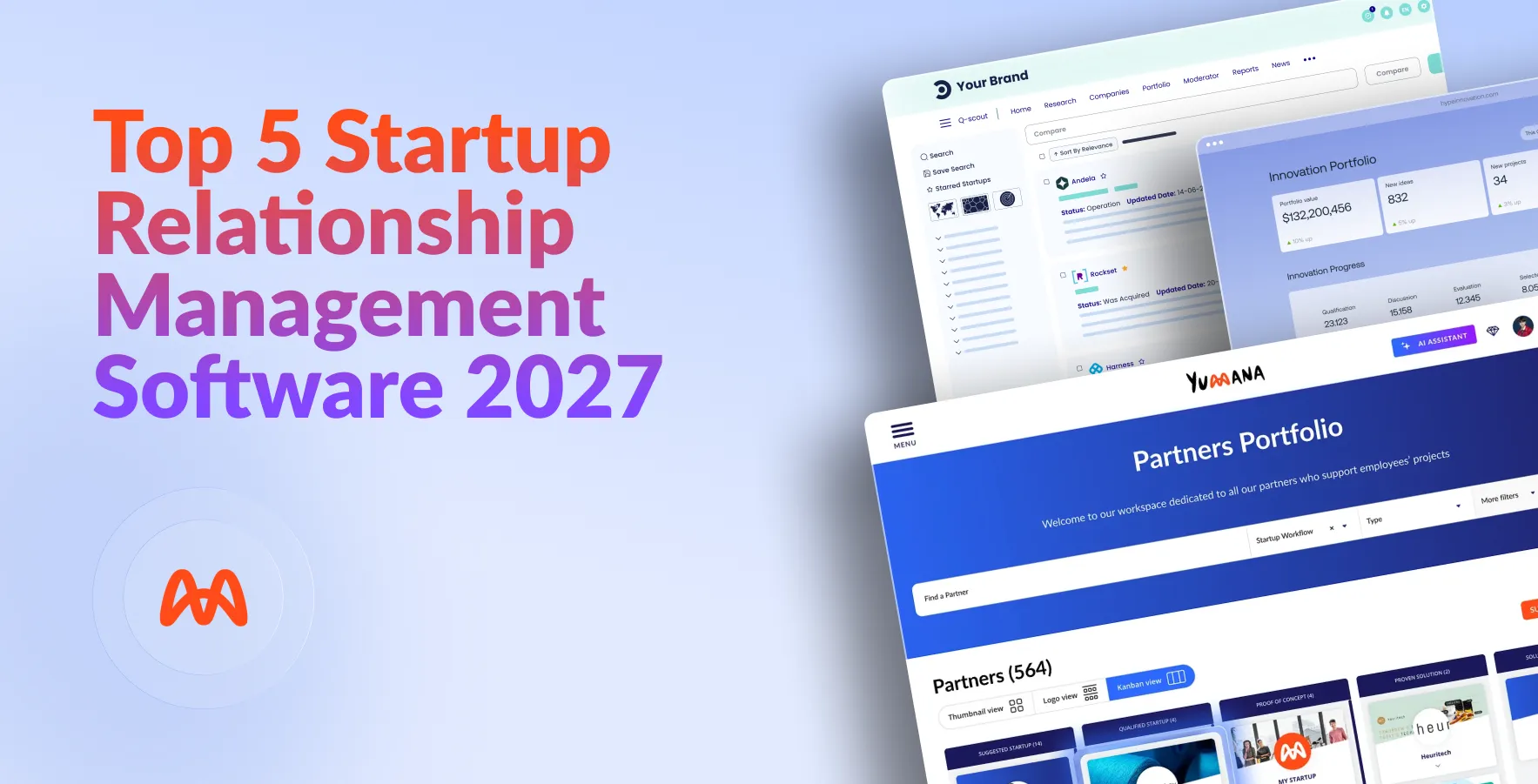
Startup Relationship Management (SRM) platforms help large enterprises structure their scouting activities, manage partners, and track startup collaborations. This 2027 comparison examines five solutions — Yumana, HYPE Innovation, Crowdworx, Qmarkets, and Questel — against ten criteria, covering everything from partner discovery and AI capabilities to ecosystem management and value measurement.
Introduction
Collaborating with startups has become an essential strategic lever for large enterprises, supporting both their innovation and growth ambitions. With their specialized expertise and remarkable agility, startups offer large organizations far more than an additional source of innovation: new technologies to invest in, projects to accelerate, and innovative solutions to explore.
Yet as open innovation initiatives multiply and ecosystems expand, a major challenge emerges: how can organizations identify the most relevant partners, determine which ones to engage, when, and for what purpose, and turn these opportunities into collaborations that deliver tangible value?
Managing a startup portfolio involves far more complexity than maintaining a simple directory. Organizations must engage partners with widely varying profiles and maturity levels, run experiments across multiple countries, coordinate relationships managed simultaneously by different business units, and establish evaluation processes tailored to each project. This complexity is compounded by the speed at which startups evolve. Funding rounds, strategic pivots, and scaling initiatives can fundamentally change their position and collaboration potential within just a few months.
As a result, maintaining a clear understanding of the ecosystem can quickly become challenging. Teams reach out to the same partners independently, information becomes outdated, insights from experiments are lost, and valuable opportunities fail to reach the business units that could benefit from them. When these situations recur, organizations struggle to build on existing collaborations and assess the value they generate.
The challenge, therefore, is to establish a comprehensive view that reflects the diversity of partners and the specific nature of each collaboration, while enabling consistent governance at the group level. Connecting local initiatives with broader strategic ambitions helps organizations maintain reliable ecosystem intelligence, coordinate activities across the business, and turn identified opportunities into concrete outcomes.
Startup Relationship Management (SRM) platforms are designed to address this challenge. They help organizations structure partner discovery and evaluation, manage relationships, support collaborations, and leverage the knowledge gained throughout each project so that every initiative can inform and strengthen the next.
While SRM platforms share a common ambition, each has developed its own areas of expertise, from startup scouting and data intelligence to collaboration management.
So, how do you choose the SRM platform that best supports your organization's ambitions?
We examined five leading solutions against 10 evaluation criteria, looking beyond their features to assess how well they address the operational realities of collaboration between startups and large enterprises.
A closer look at the 10 evaluation criteria
Startup profiles, qualification pipelines, scoring, workflows, and reporting are now core features of many Startup Relationship Management platforms.
But behind seemingly similar feature lists, vendors focus on different priorities. Some emphasize powerful scouting and technology intelligence capabilities, while others prioritize strategic portfolio analysis, opportunity management, or collaboration development.
We selected 10 criteria organized around four key priorities for Innovation teams.
These four dimensions form the foundation of our comparison and the 10 criteria used to assess SRM solutions. They address one central question: which platforms truly enable organizations to move beyond a partner directory and build a coordinated, actionable collaboration ecosystem that creates value?
The 10 evaluation criteria
1. Yumana
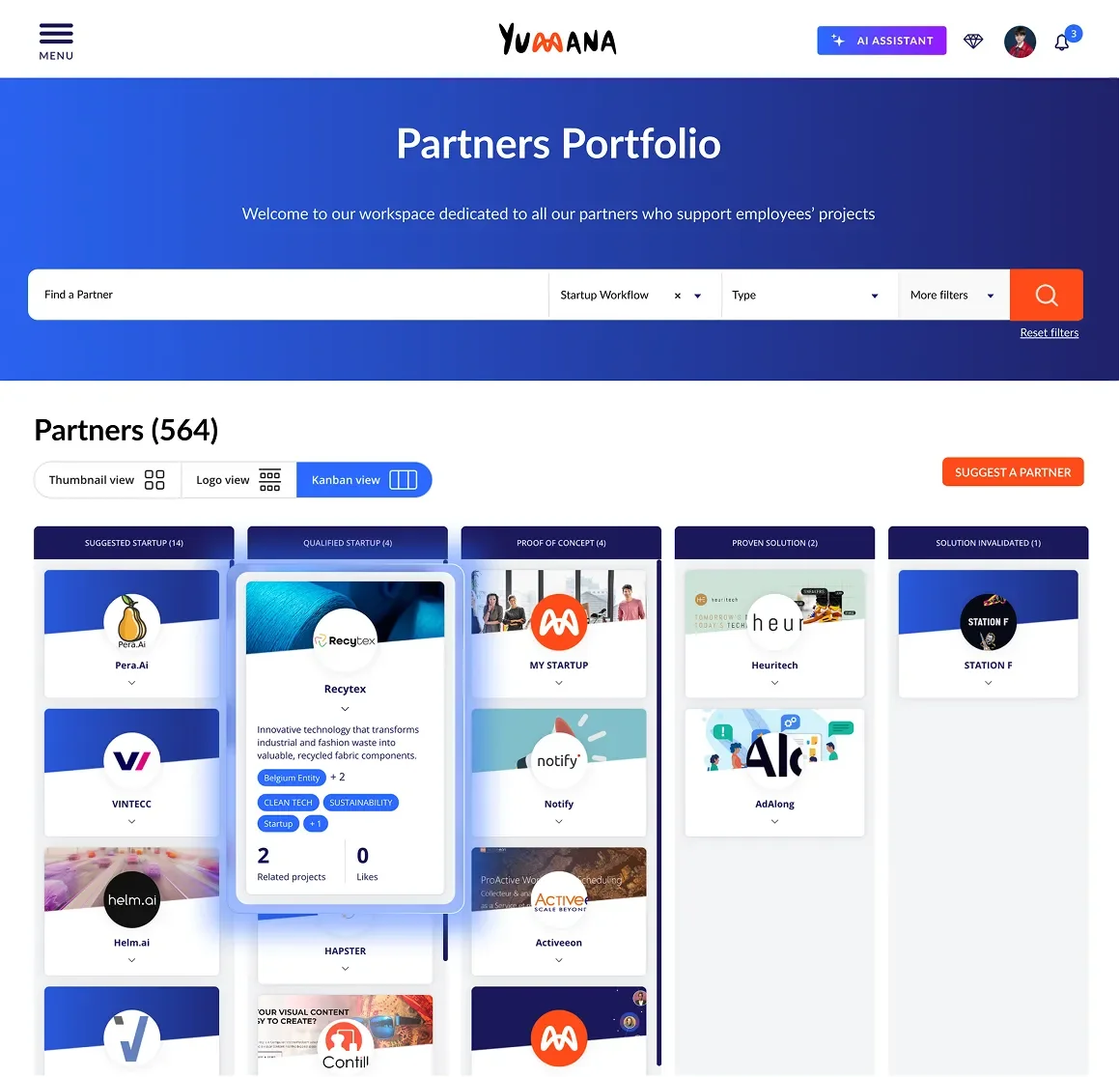
Yumana offers a comprehensive approach to Startup Relationship Management, covering the entire collaboration journey while addressing the complexity of large organizations. Its ambition is to transform the partner portfolio into a living knowledge base, continuously enriched through collaboration and designed to generate lasting value for the organization.
Yumana's roots lie in internal collaborative innovation, an experience that has shaped its strong commitment to collective intelligence and continues to influence its approach to SRM. Cross-functional collaboration and business stakeholder engagement are therefore central to its positioning, underpinned by a clear conviction: the value of a portfolio depends as much on the quality of its partners as on the collaborations teams can build with them.
The objective is to keep accumulated knowledge accessible, reliable, and actionable so that a promising introduction, a successful experiment, or expertise identified within one subsidiary can inspire new use cases and create opportunities across the wider organization.
To deliver on this ambition, Yumana combines targeted sourcing, a dynamic partner knowledge base that evolves with each collaboration, and tailored collaboration journeys. Individual teams retain the flexibility to develop partnerships that address their specific operational needs, while the group can unlock additional opportunities and extend the impact of existing collaborations.
1. A scouting approach built around precise partner selection
Yumana has partnered with Novable to deliver highly targeted startup scouting, combining AI-powered ecosystem exploration at scale with human expertise to refine the selection process.
Teams initiate their scouting brief directly within Yumana, after which Novable takes over. AI identifies companies that potentially match the search criteria, while Novable's experts assess their activities, maturity, funding, and fit with the project to determine their ability to meet corporate partnership requirements.
The result? Pre-qualified startups, carefully selected for their collaboration potential and ready to engage, rather than another list of prospects requiring further review.
Selected startups are then added to the Yumana portfolio, where teams can continue their qualification and initiate collaborations. Scouting becomes an integral part of the open innovation program, creating a seamless journey from partner discovery to collaboration.
2. Partner evaluations tailored to their specific characteristics
An early-stage startup, a scale-up operating across multiple markets, and an established technology partner should not be assessed against identical criteria or managed through the same collaboration process. Large enterprises introduce further complexity: experimentation stages, pre-contractual approvals, and co-development requirements may vary between entities.
Yumana enables organizations to create tailored partner profiles, with dedicated fields, multi-criteria scoring frameworks, and evaluations adapted to each company's maturity, technological potential, or strategic relevance.
This flexibility extends to collaboration journeys. Multiple workflows can coexist within the platform, each with its own stages, evaluation criteria, and approval processes.
Yumana can therefore accommodate the specific qualification and collaboration practices of individual entities while maintaining a shared, group-wide view of partners. Organizations retain overall consistency without imposing uniform requirements on partners, collaboration models, or governance processes.
3. AI that maintains ecosystem knowledge and helps engage the right partners
A startup portfolio evolves as the companies within it grow and change, and developments affecting a partner can significantly alter its collaboration potential. Maintaining accurate information across hundreds or thousands of profiles requires considerable effort.
This is where automation and AI become particularly valuable: enriching information, monitoring developments, verifying sources, and identifying warning signs to maintain a sufficiently reliable and up-to-date knowledge base for informed decision-making.
These capabilities also make accumulated knowledge easier to use. Contextual search, intelligent filters, relevance scores, and recommendations help teams identify partners whose capabilities match specific business needs.
Yumana offers autonomous AI agents, including:
AI helps transform the portfolio into a resource for decision-making and meaningful partner connections.
4. Shared knowledge that enables collaboration across the organization
The same startup might be running an experiment with one subsidiary while negotiating a commercial partnership with another. Each relationship follows its own path, but all can benefit from shared visibility across the group. The objective is to connect local initiatives, pool knowledge, and uncover new opportunities for collaboration.
The platform allows organizations to structure relationships by country, business unit, project, or portfolio, with access permissions tailored to individual responsibilities and confidentiality requirements.
Each partner has a consolidated history covering interactions, evaluations, projects, outcomes, and lessons learned. Business teams can review previous collaborations, share their assessments, and identify the stakeholders who can help them launch new initiatives.
Yumana enables organizations to build on the value of every collaboration while giving individual entities the autonomy to develop their own partnerships. This collaborative dimension becomes particularly valuable as ecosystems expand and more teams contribute to their development.
5. From partner portfolio management to outcome measurement
As collaborations progress, portfolio data provides valuable insights into the health of the ecosystem: partner maturity, activity across business units, emerging topics, and needs that remain underserved. By combining this information with project progress and results, analytics capabilities help teams refine priorities, guide decisions, and better understand the value generated through partnerships.
Yumana connects startup relationship management with the organization's broader innovation portfolio. Teams can manage evaluations, PoCs, co-development projects, and deployment stages while documenting the results achieved. Dashboards provide visibility into portfolio activity, conversion rates, collaboration progress, and performance indicators defined by the organization.
Innovation leaders can identify projects making progress, the most actively engaged partners, and initiatives that warrant further attention. Yumana is also developing capabilities to analyze business needs and assess how well they match the resources available within the portfolio, helping teams refine their future scouting priorities.
In summary
The platform provides a complete view of the partnership journey, from the initial identification of expertise to active projects and the outcomes they deliver.

Strengths
Considerations
2. HYPE Innovation

HYPE Innovation offers a modular suite covering several areas of innovation management, including ideation, technology intelligence, project management, and external partnerships. Its HYPE Partnering module helps teams discover, qualify, and manage partners, with a particular focus on technology scouting and Venture Clienting.
HYPE Partnering features an AI-assisted search engine providing access to an extensive, regularly updated company database. Through semantic search, scoring, and recommendations, Innovation teams can explore new markets and identify partners capable of addressing their business needs.
HYPE supports the different stages of the collaboration journey, from identifying a business need to validating an external solution and potentially deploying it. Its Partner CRM centralizes contacts, interactions, and documents, while teams can organize evaluations, coordinate pilots, and track outcomes through configurable workflows. Startups can also submit their solutions through open calls.
One of HYPE's key strengths is its ability to integrate scouting into a broader approach to technology intelligence and foresight, drawing on weak signals and market transformations. Its AI developments are primarily focused on opportunity analysis and how these opportunities contribute to the broader innovation portfolio.
This positioning gives HYPE a particularly strong focus on opportunity discovery, technology foresight, and Venture Clienting management, rather than treating partner knowledge as a resource to be leveraged across all innovation activities.
HYPE does offer a Partner CRM and tools for collaboration across business units. However, its approach may be more limited for organizations looking to extend the value of their portfolio beyond scouting, for example by leveraging previous experiences and maintaining a shared understanding of existing partners.
The breadth of the suite also requires decisions about configuration and functional scope. Several foresight, portfolio management, and innovation management capabilities are available through additional modules, while advanced configurations may require technical support.
In summary
HYPE is particularly well suited to Innovation teams, technology scouting specialists, and Venture Clienting managers seeking to identify technology partners and anticipate developments in their environment. Its offering is especially relevant for organizations where discovering new technologies and turning them into practical use cases are central to their innovation strategy.
Strengths
Considerations
3. Crowdworx
Crowdworx is an innovation management software provider offering capabilities including ideation, portfolio management, technology scouting, and collaboration with external partners. Its Startup & Technology Scouting solution covers the identification, evaluation, and management of startups and technology partners.
For partner discovery, Crowdworx draws on external databases, including Crunchbase, Dealroom, and FoundersNest. Its AI capabilities facilitate searches, enrich available information, and filter companies according to criteria defined by teams. Identified startups can then be evaluated using multi-criteria scorecards that consider factors such as technological maturity, commercial traction, and alignment with business needs.
The platform also helps structure the different stages of qualification and collaboration through configurable workflows. Teams can organize evaluations, assign responsibilities, establish approval processes, and track opportunities through experimentation, licensing agreements, or co-development projects. Information, documents, and decisions are centralized to maintain a record of activities undertaken with each partner.
Dashboards provide visibility into identified opportunities, their progress, and ongoing collaborations. The platform also offers views tailored to different user profiles, alongside access control capabilities.
Its documented AI features primarily support opportunity discovery, data enrichment, and evaluation. Capabilities such as automated updates across the entire portfolio, detection of outdated information, and recommendations for new collaborations based on previous experiences are less extensively described in publicly available documentation. Their scope should therefore be clarified when evaluating the solution.
Similarly, while Crowdworx supports evaluations involving internal experts, its public offering does not describe a standard service in which external specialists systematically conduct in-depth startup qualification based on a business brief.
In summary
Crowdworx addresses the needs of Innovation and R&D teams seeking to structure their scouting activities, standardize evaluation methods, and manage external opportunities within a shared environment. Organizations planning to deploy multiple programs or involve numerous entities should anticipate the configuration work required to adapt processes and evaluation criteria.
Strengths
Considerations
4. Qmarkets
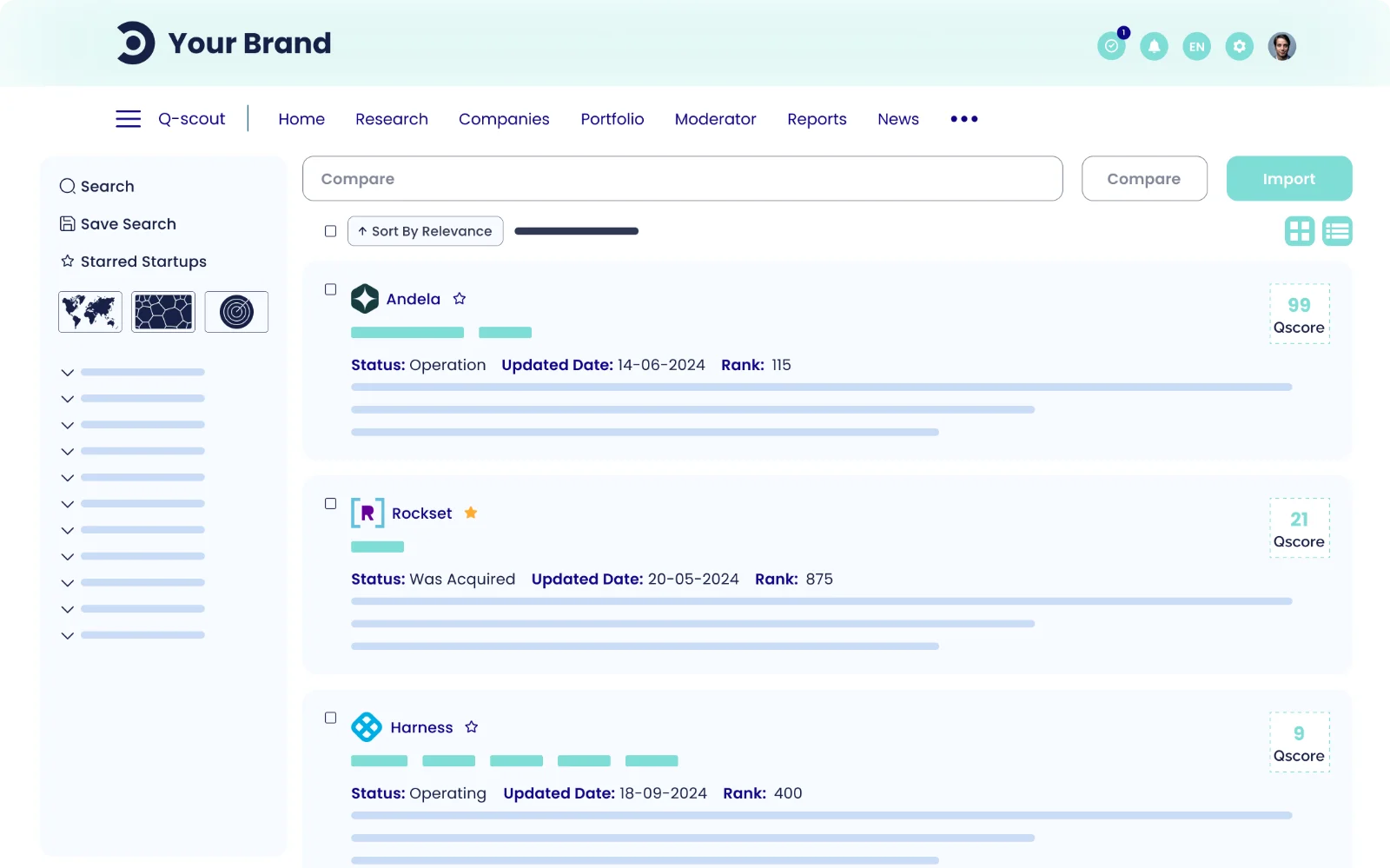
Qmarkets is an established innovation management provider whose software suite covers ideation, continuous improvement, foresight, technology scouting, and innovation portfolio management. Its Q-scout module enables teams to identify, qualify, and manage external partners, with particular expertise in discovering new technologies and managing opportunities.
The platform draws on an international database of approximately one million startups and companies, enhanced by AI and available as an optional feature. Semantic search, advanced filters, and multi-criteria evaluations help teams identify partners based on business needs. Teams can then manage opportunities through configurable workflows, engage relevant experts and decision-makers, and track experiments through to deployment decisions.
Qmarkets stands out for its ability to explore emerging trends using sources such as patents, scientific publications, and company activity. Its strategic portfolio intelligence capabilities were further strengthened in 2026 with the launch of Iris, its cross-platform AI layer. Iris analyzes information from innovation programs to uncover common themes, identify related initiatives, and highlight technologies or startups that could address business needs. Business units can also submit their priorities, engage relevant experts, and direct their searches toward the most appropriate solutions.
Startup management is therefore part of a broader approach primarily focused on opportunity discovery and strategic analysis. Maintaining individual partner relationships, accommodating diverse collaboration journeys, and managing ongoing ecosystem engagement are less central to this offering.
The breadth of the suite also makes it important to define the required functional scope. The global startup database is available as a premium option, while foresight, portfolio management, and certain AI capabilities depend on the products and services selected.
In summary
Qmarkets is particularly suited to Innovation teams seeking to identify emerging opportunities, connect them with business priorities, and inform investment decisions. For organizations whose primary objective is to develop and maintain a partner ecosystem, the capabilities specifically dedicated to collaboration management should be assessed within the scope of Q-scout.
Strengths
Considerations
5. Questel (formerly Yoomap)
Questel is a group specializing in intellectual property software and services, as well as technology intelligence. In 2019, it acquired Yoomap, a French provider of innovation management and startup relationship management solutions.
Yoomap's original SRM software was primarily designed to centralize, structure, and track relationships with external partners. It enables Innovation teams to build a startup portfolio, document partner characteristics, organize evaluations, and manage opportunities through customizable workflows. Its capabilities include partner profiles, multi-criteria scoring frameworks, search and filtering tools, access permissions, and dashboards.
The platform also provides collaborative features that allow different teams to share evaluations, maintain interaction histories, and track projects undertaken with partners. It therefore addresses the fundamental requirements of structuring and coordinating Open Innovation programs.
Its main limitation concerns automation and the integration of artificial intelligence into day-to-day portfolio management. In the original SRM version, creating and updating startup profiles relies primarily on manual processes. Teams must enter information, verify its accuracy, and perform the necessary updates to maintain the quality of their partner database.
Historical Yoomap documentation mentions recommendation algorithms and automated news updates. However, these capabilities do not match the more advanced AI applications now sought in SRM platforms: AI-assisted contextual search, intelligent profile enrichment, proactive detection of outdated information, partner reassessment, or autonomous agents capable of recommending actions based on business needs and collaboration history. These capabilities were not identified within the scope of the software reviewed.
This reliance on manual work presents an operational challenge for organizations managing hundreds or thousands of startups. Portfolio reliability then depends directly on the time teams devote to collecting, verifying, and updating information.
Questel also has recognized expertise in intellectual property and technology intelligence. The group offers patent search, technology mapping, and competitive intelligence solutions that can complement the scouting activities of Innovation and R&D teams. However, these capabilities belong to separate offerings and should not be considered features directly integrated into Yoomap's original SRM software.
Finally, sourcing and qualification rely on the search and evaluation tools made available to users. An integrated scouting service combining AI-powered discovery with in-depth expert qualification based on a business brief is not presented as part of the standard SRM process.
In summary
Yoomap's original SRM solution is suited to organizations seeking to centralize their startup portfolio, structure evaluation processes, and coordinate collaborations. Companies looking for a platform that can automatically maintain their partner database, leverage partner data through AI, and proactively identify new opportunities should carefully examine the available features and the product's development roadmap.
Strengths
Considerations
Comparison table: 5 Startup Relationship Management platforms
Functional coverage documented in the solutions reviewed.
Rating definitions
- Documented: the capability is explicitly described in the solution's offering.
- Partial: certain aspects of the criterion are documented, but they do not cover the full scope of the defined requirement.
- To confirm: available documentation is insufficient to determine the scope or availability of the capability.
- Not identified: the capability was not identified in the sources reviewed, without implying that it is absent.
Comparison conducted by Yumana based on the features presented in vendors' documentation and our knowledge of the solutions reviewed. Ratings reflect the documented level of functional coverage and do not constitute an independent assessment of software performance. Some capabilities may require additional modules or services.
Conclusion: the true value of a startup portfolio lies in the relationships it enables
Access to a million startups, algorithms capable of identifying the next promising technologies, dashboards that uncover market trends: SRM platforms have significantly expanded their capabilities. Yet their greatest value still lies in their ability to foster lasting collaborations.
Different approaches coexist in the market. Some solutions specialize in discovering new partners and exploring emerging technologies, while others focus on opportunity qualification, experimentation management, or strategic innovation portfolio analysis.
For large enterprises, one recurring challenge appears to stand out: what happens to the knowledge accumulated about a startup once it enters the portfolio? Is that information still reliable a year later? Should an early-stage startup and an established technology partner be evaluated in the same way? When one subsidiary establishes a collaboration, can other entities find that experience, understand its outcomes, and build on it themselves? And, most importantly, do teams have enough autonomy to develop their own partnerships without fragmenting knowledge across the group?
These questions reveal a defining dimension of Startup Relationship Management: value lies not only in the partners an organization discovers, but also in the relationships it builds, the knowledge it develops, and the opportunities it can generate from every collaboration.
This is the foundation of Yumana's approach. Because the true potential of an ecosystem is not measured by the number of startups a company identifies, but by everything it manages to build with them.
FAQ
CEO & Co-Founder