Blog
7 MINS
Companies are looking further afield for innovation. Emerging technologies and disruptive solutions are multiplying across a fast-moving startup ecosystem, opening up new opportunities for collaboration between startups and large enterprises. But this abundance also raises a difficult question: among thousands of promising startups, how can companies identify those genuinely ready to enter into a partnership with a large organization?
The obstacles are familiar to corporate teams: negotiations stalled by unexpected contractual or regulatory requirements, successful pilots that never make it to deployment, or production and support capabilities that cannot keep pace with a sudden increase in scale. Yet these issues are often overlooked at the outset, only coming to light after months of discussions, investment and internal effort.
Startups and other innovative partners are, of course, regularly assessed against a range of indicators: technology maturity, growth prospects, commercial traction, funding rounds and market potential. These provide useful insights into a company's strength and development trajectory. But they leave out a critical dimension: whether the startup can actually meet the requirements of working with a large enterprise.
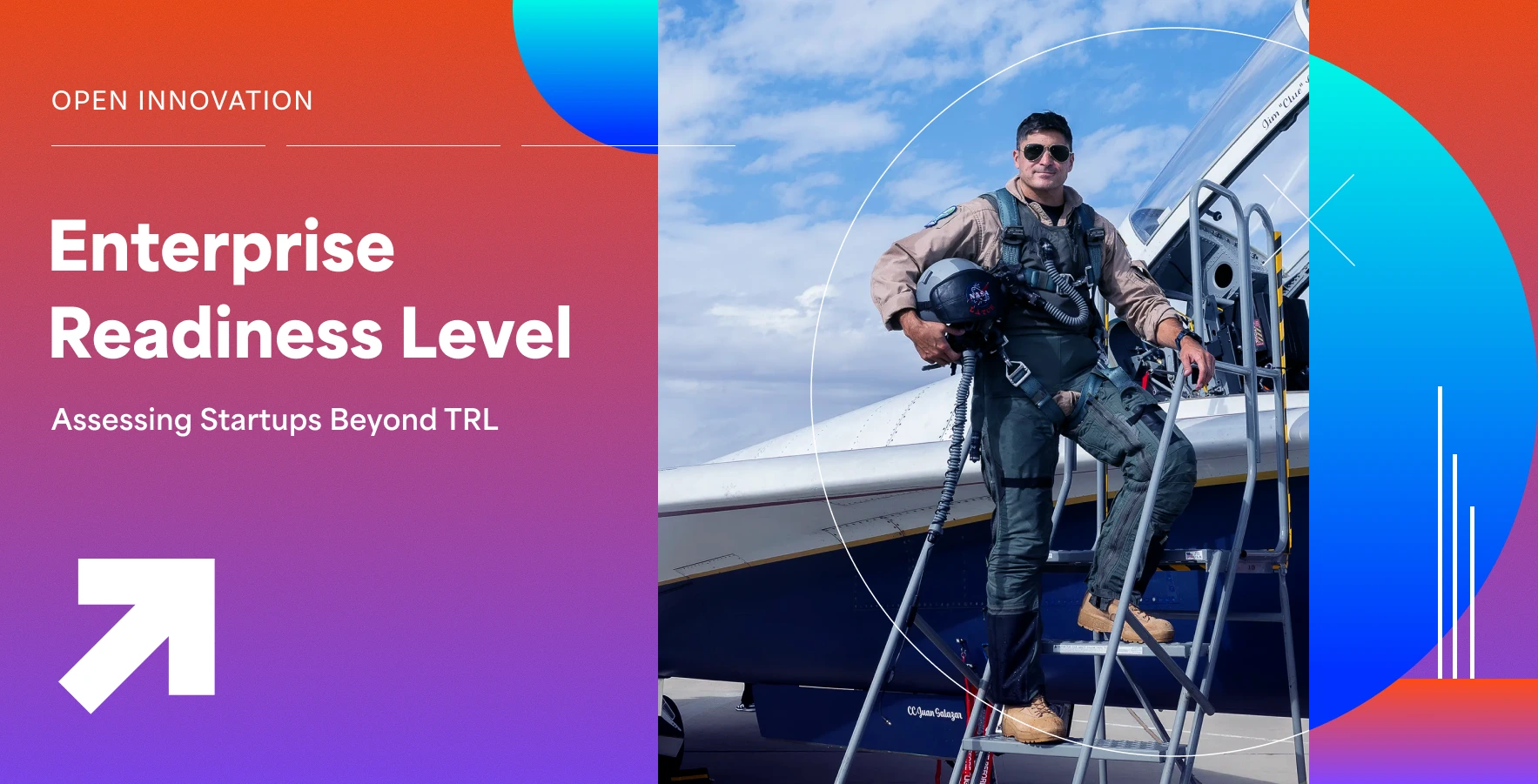
Developed by Novable, the Enterprise Readiness Level (ERL) aims to address this gap. Based on objective, verifiable criteria, this new framework gives structure to a dimension that has long been difficult to assess consistently: how prepared a startup is to collaborate with a large organization. While the Technology Readiness Level (TRL) measures the technological maturity of a solution, ERL brings other factors essential to a successful partnership into the assessment. The goal is to look beyond a startup's inherent potential and evaluate its actual readiness to become a partner, improve the selection of innovative companies, and give large enterprises a more informed basis for engaging with startups in their ecosystems.
Technology Maturity and Partner Reliability: 2 Different Measures
Originally developed by NASA, the Technology Readiness Level has become a widely used framework for assessing technological maturity. Its nine-level scale traces the path from basic scientific principles to validation in operational conditions, giving companies a common reference point for evaluating how far a technology has progressed.
TRL naturally plays a central role in startup evaluation and selection, particularly in industrial and technology-driven sectors, where technology is often a young company's main competitive differentiator.
But treating technological maturity as the primary guarantee of a successful partnership can blur an important distinction: the performance of an innovation is not necessarily evidence of the strength of the organization behind it. A technical breakthrough, however impressive, does not in itself prove that a company can industrialize it, deploy it, or meet the demands that come with sustaining it over time. Even a proven technology says little about whether the company behind it can meet a large enterprise's expectations.
Traditional startup qualification criteria also borrow heavily from the world of venture capital. Yet investors and corporate customers are not looking for the same assurances. A high-profile funding round does not guarantee service continuity, nor does it establish the robustness of a startup's security, compliance or support processes.
In his book Enterprise Readiness Level: Not Every Startup Is Ready for the Enterprise, Laurent Kinet examines this recurring error of judgment: assuming that evidence of technological or entrepreneurial success also demonstrates readiness for corporate collaboration.
When Incomplete Qualification Derails a Partnership
Without a shared framework specifically designed to assess this readiness, incompatibilities may only emerge at an advanced stage of the relationship: during contract negotiations, cybersecurity audits, technical integration or scaling. By then, the large enterprise may have committed business teams, specialist expertise and financial resources for months. The startup, meanwhile, may have devoted a significant share of its capacity to a project whose conditions for success were never in place.
Not every discontinued experiment is a failure. A proof of concept (PoC) that disproves a hypothesis has served its purpose. But when a collaboration breaks down because of a structural limitation that could have been identified from the start, the initial qualification process deserves scrutiny. Assessing organizational readiness earlier can help prevent avoidable setbacks by clarifying the conditions required for a partnership to work.
For Laurent Kinet, the causes of these breakdowns are rarely where teams first look:

When a collaboration fails, everyone looks at the technology first. In my experience, the reason for failure usually sits in surrounding areas: compliance, IT security, operational excellence, or financial robustness. I see ERL as innovation risk management, a way to check those things before you sign, while you can still do something about it.
Laurent Kinet
Cofounder & Chairman, Novable
ERL: A New Way to Assess the Ability to Collaborate
ERL grew out of practical experience. After seven years of scouting startups and observing relationships between startups and large enterprises, informed in part by interviews with around 200 professionals across innovation, procurement and the startup ecosystem, Novable set out to formalize the criteria that indicate whether a prospective partner is genuinely ready to work with a corporate organization.
The ambition is to turn what is often an intuitive judgment into documented, comparable information that can support decisions.
How? By examining six dimensions of a company: its identity, how clearly its offering is defined, its technical and production capabilities, its preparedness for security and compliance requirements, its commercial traction, and its operational robustness.
This multidimensional approach defines five levels of readiness, ranging from the concept stage to the ability to support large-scale deployments. Ultimately, it helps clarify what a startup can realistically commit to delivering.
Rather than relying on reputation or sales claims, which inevitably introduce subjectivity, ERL emphasizes tangible evidence and observable, verifiable criteria. Its guiding principle is to make a company's capabilities as clear and shareable as a technology's maturity level.
4 Ways ERL Can Improve Open Innovation Performance
In an Open Innovation program, poor qualification rarely has an isolated cost. Its effects extend to budgets, timelines, internal resources and sometimes the credibility of the innovation program itself. By providing a more precise, earlier assessment of organizational capabilities, ERL can support better decisions and help companies refine their Open Innovation strategies.
Here are four practical benefits.
1. Allocate External Innovation Resources More Effectively
While startup scouting can generate a substantial pipeline of potential partners, in-depth qualification is costly. It may require input from business, technical, legal and financial specialists, whose time and availability are often limited.
ERL adds an initial layer of assessment before these teams become involved. Used as a prequalification tool, it can help coordinate efforts, avoid committing scarce resources too early to structurally unsuitable partnerships, and preserve more capacity for opportunities with genuine value-creation potential.
2. Anticipate Execution Risks Before Contracting
Large enterprises already have rigorous supplier due diligence processes, and ERL is not intended to replace them. The problem is that these checks often take place late in the process.
ERL enables teams to identify potential concerns earlier and adjust the terms of engagement accordingly. A startup may be well suited to exploratory work without yet being equipped to support a major industrial deployment. The right decision depends on what the company expects the startup to deliver.
This is where ERL can help teams distinguish between different types of partnerships, taking into account industry requirements, project ambitions and the responsibilities involved. The aim is to make the level of scrutiny proportionate to the commitment being made, reducing risk without discouraging experimentation.
3. Identify Partners That Traditional Criteria May Overlook
By including organizational readiness in its selection criteria, a large enterprise gains a more complete view of the market. Beyond visibility and commercial appeal, it can identify startups with the capabilities needed to engage in a partnership.
ERL could therefore change which companies make it onto shortlists, bringing forward startups that conventional scouting criteria might have overlooked: perhaps less prominent, but better prepared to deliver.
4. Turn Startup Qualification into Shared Organizational Knowledge
In complex organizations, startup assessments often depend on local practices. Business units and subsidiaries may use different criteria or scoring frameworks, while Procurement, IT and business teams evaluate potential partners from their own perspectives.
This diversity of expertise does not always translate into shared knowledge. Information remains fragmented, findings are difficult to reuse, and a startup assessed by one entity may have to go through the entire qualification process again with another.
A common framework can make assessments easier to share without requiring every team to make the same decision. By establishing a shared set of criteria, ERL provides a common basis for understanding a startup's readiness, which each team can supplement with its own requirements.
The benefits are both operational and organizational: fewer duplicate assessments and smoother coordination between Innovation, Procurement, Legal, IT and business functions.
For multi-entity companies, startup qualification can become knowledge that is reusable across the organization.
This approach can be put into practice through Yumana's Startup Relationship Management (SRM) platform. Its customizable scorecards allow Innovation teams to translate ERL criteria into evaluation frameworks and integrate them into their startup qualification processes. The resulting assessments can then be structured and shared across teams and entities.
Toward a New Discipline for Qualifying Innovation Partners?
Innovation leaders know that a full pipeline does not necessarily translate into an effective innovation strategy. The number of startups identified, meetings arranged or pilots launched still has a place in performance dashboards. But what ultimately matters is the value these initiatives create. Teams are increasingly expected to demonstrate why partnerships are worth pursuing, how resources are allocated, and what those collaborations actually deliver over time.
ERL contributes to this goal as a prequalification tool. Alongside technology assessments, business expertise and specialized due diligence, it sheds light on a startup's organizational readiness and helps determine whether that readiness is sufficient for a meaningful partnership.
For ERL to become a reliable, shared reference, it will need to be tested in practice, its weightings refined, and its findings compared with real-world outcomes. This is the broader point of Laurent Kinet's work: the ability to collaborate deserves to be assessed in its own right.
For large enterprises, the implications go beyond selecting startups. They concern how companies govern their external innovation relationships and turn identified opportunities into partnerships that create lasting value.
Further Reading
Enterprise Readiness Level: Not Every Startup Is Ready for the Enterprise
In his book, Laurent Kinet examines the observations that inspired the Enterprise Readiness Level and the foundations of a framework designed to assess whether innovative companies are prepared to meet the requirements of large corporate customers.
From measurement principles to governance challenges, the book offers Innovation leaders, partnership managers and decision-makers a deeper perspective on how to assess, qualify and engage future partners.
Explore Novable's work on the Enterprise Readiness Level to learn more about this approach to assessing startup organizational readiness.
CEO & Co-Founder