.png)
Video
16 MINS
If you’re an Innovation Director or responsible for an intrapreneurship program, you already know how strategic this topic is… and sometimes how difficult it can be to implement.
Why launch a program? What real benefits can you expect, both for business and HR? What pitfalls should you avoid? And most importantly: how do you ensure your initiative creates real value for your company?
In this video, I’ll share practical advice, real feedback from the field, and a clear framework to help you succeed.
At Yumana, I’ve spent more than ten years helping large organizations launch and scale intrapreneurship programs thanks to both our operational expertise and our innovation management software designed to support corporate entrepreneurs.
Why launch an intrapreneurship program?
Companies rarely have just one motivation.
But in practice, four major goals almost always come up.
The first is business growth.
Organizations need to renew themselves, anticipate market shifts, and explore new opportunities. Intrapreneurship allows them to create innovative projects driven by internal employees who already understand the company’s constraints, culture, and customers. The goal is simple: create new business, new offers, and new business models.
The second objective is operational performance.
Not every project is disruptive. Some simply improve a product or a service, develop new ways of working and internal practices, or digitalize an activity. And very often, these “field projects” deliver the fastest ROI.
The third objective is cultural transformation.
Intrapreneurship helps employees take initiative, experiment, and move from execution to action. It accelerates innovation culture inside the organization.
The fourth objective is talent development.
Many high-potential profiles never appear through traditional HR processes. Intrapreneurship reveals them. These employees can become leaders, internal ambassadors, or transformation drivers.
And increasingly, companies also want agility: adopting startup-like ways of working without destabilizing the core organization.
But, is your company ready?
The essential conditions for success
Let’s be clear: intrapreneurship is not the first step of an innovation program.
If your organization has never run ideation campaigns, or collaborative innovation programs before, it might be too early.
Why? Because intrapreneurship requires: coordination, time, managerial flexibility, and organizational maturity.
Without that, you may have a beautiful program on paper… but very little impact. And the result is predictable: few projects, disappointed employees, and disengaged sponsors.
For your program to work, there are foundations you must establish
First: a strong executive sponsorship.
Support from top leadership gives legitimacy and removes internal blockers.
Second: having a clear governance.
Who decides? Who coaches? Who validates? Steering committees, juries, and business sponsors must be defined from the start.
Third point: having shared objectives
And I really want to emphasize the word shared.
This isn’t an HR gimmick or the CEO’s latest pet project.. Everyone needs to understand what the program is aiming for: more business? a cultural shift? a transformation in the way the company is managed?
It has to be clearly stated, written down, and understood by everyone.
Fourth point: funding.
Not only for the program itself, but also for the selected projects. Nothing kills motivation faster than hearing: “Great idea… but there’s no budget.”
And finally, you need to think about the intrapreneur’s journey.
What milestones will structure the program? How will intrapreneurs be supported, coached, and recognized? And above all, how will you give them both the desire (and the time) to truly commit?
The key steps to building a robust and credible program
Now that we’ve looked at why to launch an intrapreneurship program, let’s move on to the key question: how do you actually build one in practice?
The first step is stakeholder alignment, especially top management.
Through interviews and workshops, you clarify expectations and concerns. This is an essential step to align everyone on the program's objective.
The second step is to identify potential obstacles.
Because every company has its own barriers: it might be a culture that is too focused on the short term, employees who lack the time, or difficulty freeing up talent.
The goal here is to anticipate these challenges so you can put workarounds in place.
It’s also upstream that you define KPIs. Not only for the program itself - like the number of applications, the engagement rate or participation dynamics - But for the projects too: their level of maturity, their impact, and their business potential.
Then you define the rules of the game: Who can apply? What are the selection criteria for ideas and project leaders? What is expected from the participants?
The more transparent you are on these points, the more you build trust and engagement.
And then, of course, there is the intrapreneur’s journey. From the initial idea to the industrialization of the project, with all the stages of support, coaching, and validation.
And above all, there’s what comes next: what happens to the intrapreneur once the project is completed? Do they return to their previous role? Are they promoted? Do they have the opportunity to join a spin-off?
All these questions need to be addressed from the very beginning to reassure candidates and encourage them to participate.
One of the key factors in the success of your intrapreneurship program is integrating it into your overall innovation strategy.
It complements other levers such as open innovation, continuous improvement initiatives, and venture clienting. Since the first concrete results of an intrapreneurship program can take time to emerge, it's recommended to implement an hybrid approach and rely on mechanisms that deliver a rapid ROI to maintain the dynamic of innovation.
The main obstacles… and how to overcome them (proven models inspired by LVMH, Michelin, Safran, Accor…)
Now that we have a clearer understanding of how to design a program, I recommend considering the obstacles you might encounter when implementing and managing it.
The first obstacle is short-term pressure from business units.
The consequence is simple: it becomes difficult to mobilize teams or fund projects.
A solution we often recommend, and which has proven to be effective in companies such as LVMH, Michelin, or Safran is to split the funding.
- The innovation department finances the early stage, the incubation phase.
- Then, once the value has been demonstrated, business units take over after exploration or proof-of-concept phases.
The second obstacle is the lack of business anchoring. The intrapreneur becomes isolated, and the project struggles to find an operational owner.
For example, Richemont introduced an early sponsorship phase, where business sponsors follow projects from their very beginning. This really improves both adoption and long-term continuity.
The third obstacle is employee availability.
To address this, some organizations, like Siemens, run two separate calls: one call to collect ideas, and another to identify employees who actually have the motivation, the time and skills to carry the projects forward.
Finally, the fourth challenge is: too many ideas… but not enough breakthroughs.
In this case, the key is to create two separate tracks: one for incremental innovation and another for truly disruptive projects.
This is exactly what the Accor Group did, leading for example to the “JO&JOE” concept, which originated from their intrapreneurship program.
Why a digital platform is essential to structure and scale your program
Once these obstacles are understood, one essential lever remains to maximize success: it’s the digital platform.
Its importance is underestimated, and yet, it completely transforms the program dynamics.
This is where employees apply, submit ideas, and build teams. It is also where they learn, ask questions, and find inspiration.
So we are far beyond a simple online form.
We are talking about a real community space, a living, interactive environment where intrapreneurs can exchange with each other, read alumni testimonials, discover methodologies such as design thinking, and access tutorials explaining how to build a Business Model Canvas or a business plan.
The platform also allows the program team to track progress, monitor KPIs, and coordinate interactions between coaches, sponsors, and stakeholders.
It plays a structuring role by giving visibility on milestones, deadlines, expected deliverables, and program stages.
In short, it’s an operational, educational, and cultural tool, all at the same time.
How to showcase your intrapreneurs internally and externally
Okay, now that the program is structured and supported by the right tools…
How do we create visibility and recognition around it?
First, let’s talk about what we can do internally.
We obviously need to highlight the intrapreneurs: share their stories, showcase their journeys, create portraits, and create events where they talk about their experience. They can also support future participants through mentoring or co-coaching.
But we must not forget their managers. They are often the ones who agree to release their best talents, and that is not easy. Recognizing them through interviews, speaking opportunities, or testimonials during seminars is essential to maintain engagement.
Then comes external communication.
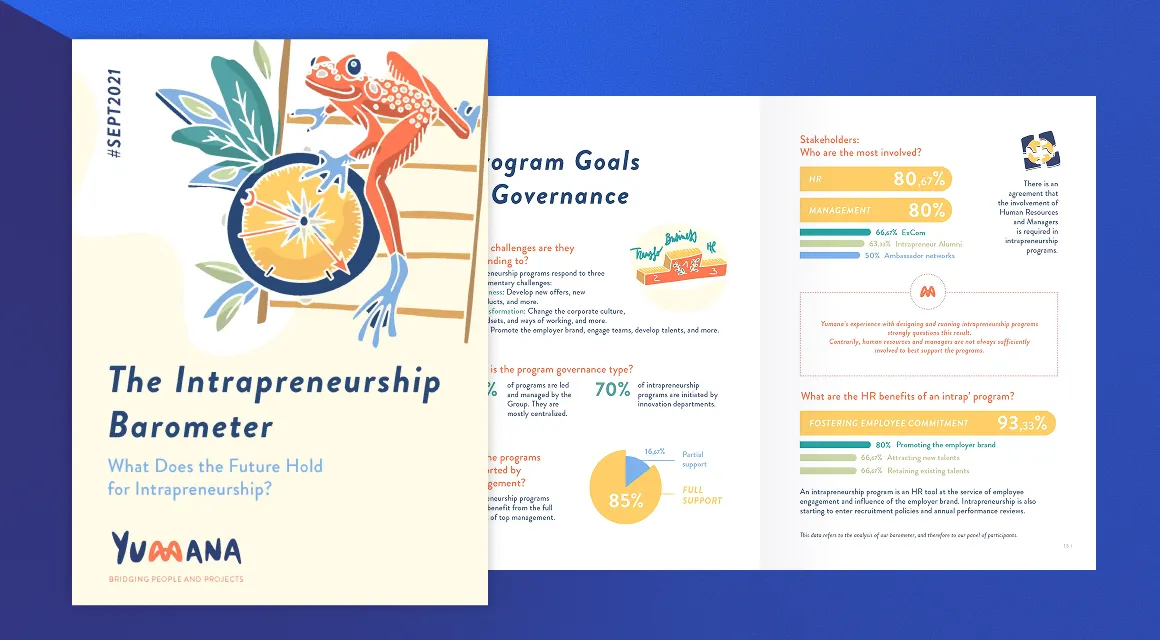
Intrapreneurship is a powerful employer-branding tool. Candidates, especially younger generations, are looking for companies offering autonomy, impact, and responsibility.
Highlighting intrapreneurs on career pages, LinkedIn, student forums, or events such as VivaTech can strongly improve your attractiveness.
Some organizations go even further by involving intrapreneurs in internal juries or inviting them to speak at HR conferences. They become ambassadors of transformation.
There is also the HR and learning dimension.
Intrapreneurship is not a temporary experience. Companies may create certifications, assess skills through feedback sessions, reviews, integrate the experience into annual evaluations, and even include it in career promotion or mobility criteria.
Over time, organizations can build a pool of trained intrapreneurs: people capable of leading strategic initiatives, taking risks, and mobilizing teams, essentially corporate entrepreneurs who can be activated for high-value projects.
And finally, an important lever is the financial recognition.
Some companies offer bonuses, equity participation, stock options, or opportunities to join spin-offs or subsidiaries. This is essential as it recognizes both commitment and risk-taking.
The KPIs that prove your program actually creates value
Let’s move on to the last point I wanted to talk to you about (but not the least): how do you demonstrate the business value of your intrapreneurship program?
This is the question every innovation leader asks.
You need to justify budget, prove impact, and convince operational teams.
The good news is that measurement exists at multiple levels.
First, quantitative KPIs:
- number of ideas submitted,
- conversion into POCs or industrialized projects,
- projects integrated into business units,
- and eventually revenue generated.
But qualitative KPIs are just as important:
- participant satisfaction,
- employee engagement,
- internal visibility of the program,
- and newly developed skills.
It’s very useful to compare the investment in intrapreneurship with investments sometimes made in open innovation, acquisitions, or startup equity participation.
Often at a much lower cost, intrapreneurship explores very similar opportunities, but with stronger cultural alignment, easier integration, and higher employee engagement.

A successful program in a few words
To conclude, a successful intrapreneurship program is one that checks several boxes:
- It aligns with the overall innovation strategy.
- It mobilizes top management and business units.
- It relies on a clear, fair, and engaging framework.
- It values intrapreneurs before, during, and after the program.
- And above all, it creates value for the company, for employees, and for the broader ecosystem.
But none of this happens by accident. It requires a method, the right tools, and field experience.
If you are considering launching an intrapreneurship program (or improving an existing one) I would be happy to discuss it with you.
CEO & Co-Founder