Blog
7 MINS
An intrapreneurship program doesn’t have to follow a single framework. How a company sources, evaluates, tests, and develops projects depends on where those projects stand. Innovation challenges, bootcamps, incubators, accelerators, and venture builders each have a different role to play along the journey.
These models aren’t mutually exclusive. A company can combine them to build a program around its objectives and the projects it wants to support. The key is knowing which model to use, when to use it, and how much time, funding, and support the organization can realistically commit.
From Idea Generation to Deployment: When to Use Each Model
These building blocks come into play and can be combined at 3 key stages of the journey:
- Early stage: Identify opportunities and assess their potential.
- Mid-stage: Test promising projects and decide which ones to take forward.
- Late stage: Help validated projects move toward deployment, integration, industrialization, or greater independence.
A program doesn’t need to include every model. If a company already has a pipeline of projects, it may not need another innovation challenge or bootcamp. Later on, acceleration, adoption by a business unit, and venture building offer different routes forward, depending on where each project can find a home.
How to Combine Intrapreneurship Models Into a Program That Works
There's no one-size-fits-all formula. Combining models means more than putting them one after another. At each transition, the company needs to know what a project must demonstrate to move forward, who makes the decision, and which criteria apply.
The challenge is to strike a balance. Put every project through the same journey, and some will receive support they don’t need. Create a completely different process for each one, and the program becomes difficult to manage.
At every stage, teams need a way to decide whether to continue, pivot, stop, or commit more resources based on the evidence gathered.
This progression requires governance suited to the decisions made at each milestone:
- Early stage: A selection committee assesses the quality and strategic relevance of opportunities.
- During incubation: Business units, experts, and sponsors help evaluate the evidence projects have gathered.
- Late stage: Future project owners, potential funding departments, and the relevant governance body take a more direct role in decisions.
Which Sequence Is Right for Your Intrapreneurship Program?
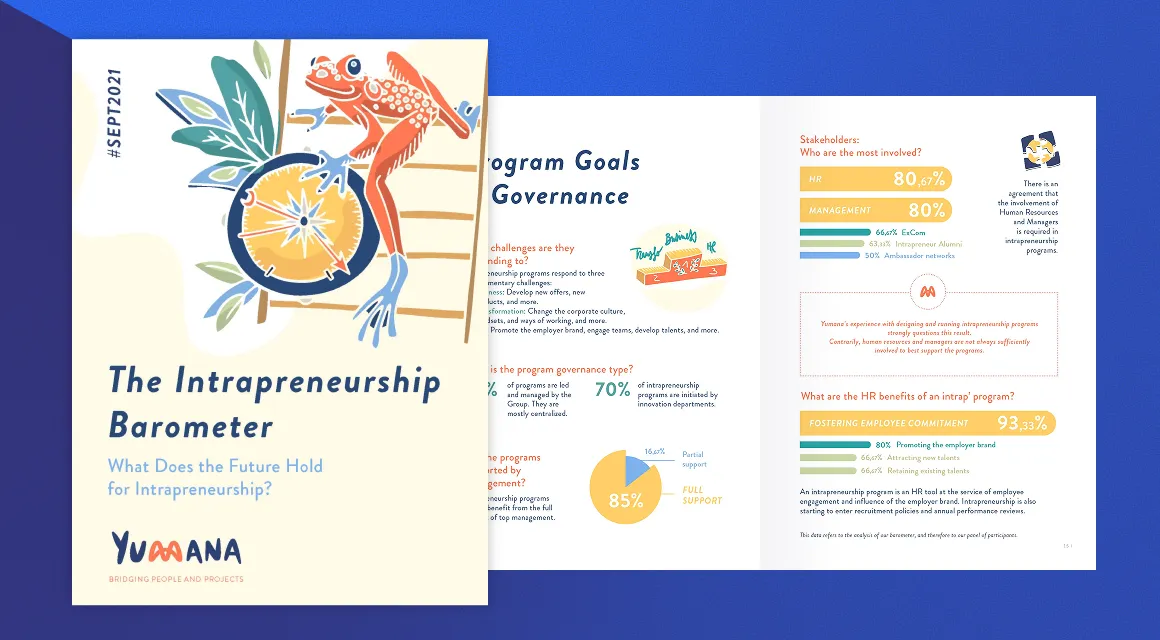
Before making a choice, consider this finding from Yumana's 2025 Intrapreneurship Barometer: 56% of programs emphasize the connection between ideas and talent, while 61% of programs that have been running for more than five years identify employees as their primary success factor.
In other words, choosing the right sequence depends not only on project maturity, but also on how the company plans to identify potential intrapreneurs and bring the right people together around each opportunity.
Do you need to identify project leaders as well as ideas?
Bring promising opportunities together with the people who have the skills and motivation to lead them.
Once a project has demonstrated its value, where can it go next?
Are you starting from scratch and looking for a broad range of opportunities?
You need to source, qualify, and then select the projects worth testing.
Do you already have ideas that need further qualification?
There’s no need to run another innovation challenge. Focus on strengthening teams, challenging proposals, and selecting the projects ready for incubation.
Do you already have qualified projects and teams in place?
Move straight into testing project potential, then give validated projects a clear route toward deployment.
Are you exploring a specific strategic opportunity outside the core business?
A broad call for ideas adds little value here. The priority is to test the opportunity and, if it proves viable, find the right structure to take it forward.
Source : Yumana Intrapreneurship Barometer 2025
110 companies surveyed, from 1,500 innovation leaders contacted across Europe.
How Our Clients Combine Intrapreneurship Approaches
The programs Yumana supports combine models in different ways. In some companies, an innovation challenge becomes a defining moment for the organization.
In others, separate calls for ideas and talent help build the right teams. Some journeys span several years, giving industrial projects the time they need to demonstrate their potential.
Three examples illustrate these approaches.
LVMH - Innovation challenge → Event-based bootcamp → Selection → Incubation.
With DARE, the challenge does more than generate ideas. Over three days, teams develop selected projects with support from mentors, executives from LVMH’s Maisons, and external entrepreneurs before pitching them to a jury.
The bootcamp turns a campaign spanning dozens of Maisons into a shared, high-profile experience that sets the pace for the next stages of the program.
TF1 - Call for ideas + Call for talent → Matchmaking → Bootcamp → Incubation.
TF1 gives employees two ways to take part: they can submit an idea, apply to become an intrapreneur, or do both. Teams are then formed around the selected projects and candidates.
The objective is to bring each promising idea together with someone willing to lead it and the skills needed to make it work.
Safran - Ideation → Voting → Team building → Bootcamps → Exploration → Incubation.
Three residential bootcamps give the journey structure and momentum without trying to fit the entire development process into a few days. Exploration and testing continue after the bootcamps.
The program is designed for industrial projects that can take years to develop. From the outset, the model was also intended to be replicated across other companies in the Safran Group.
The same models can create very different programs. What matters is choosing a sequence that fits the company’s culture, business functions, and actual project timelines.
Further reading: explore our examples of intrapreneurship programs.
What Each Intrapreneurship Model Needs to Work
Ready to get started? Each model has its own requirements. Here’s what should be in place before getting started.
Innovation challenge: must-haves
- A clearly defined scope
- Regular, engaging campaign activities
- A committee empowered to make decisions
- A planned next step for selected ideas
Bootcamp: must-haves
- Available experts
- Quick access to real-world testing
- A qualification method
- Coaches
- A clearly defined exit milestone
Incubation: must-haves
- Time genuinely freed up for the project
- A seed budget
- Sponsors
- Access to customers and business units
- Clear progression milestones
- Go/pivot/no-go governance
Acceleration: must-haves
- Solid evidence already established
- A designated owner within a business unit
- A deployment budget
- Operational support
- An adoption or scaling plan
Venture building: must-haves
- A sufficiently validated opportunity
- A dedicated team
- A specific governance structure
- Appropriate funding
- A clear hypothesis about the structure to be established
Whatever the model, five conditions remain essential: time genuinely set aside for projects, a budget suited to their maturity, access to the right expertise, governance that can make decisions, and a clear view of what comes next.
Disruptive vs. Incremental Innovation: Why the Journey Changes
Project maturity isn’t the only factor to consider. Whether the objective is to improve the existing business or explore something more disruptive also shapes the journey from the outset.
Projects close to the core business can draw on assets the company already has: customers, expertise, distribution channels, teams, data, and budgets.
It may also be possible to identify the business unit that will take ownership of deployment or industrialization early on. The path is often easier to plan: incubation, validation, business unit adoption, and deployment.
When opportunities moves further from the core business, they may require capabilities the company doesn’t yet have: new use cases, markets, business models, partners, specialist skills, or even dedicated teams and governance.
Their development is less straightforward. Incubation may take longer, tests may be more demanding, and teams could need more evidence before decisions can be made. The project may also need increasing independence.
Decision criteria, timelines, and resources should reflect that difference. A project designed to improve existing operations shouldn’t be assessed over the same time horizon as one exploring an entirely new growth opportunity.
The further a project moves beyond the core business, the more important its future organizational home becomes. For a validated opportunity that doesn’t fit within an existing business unit, venture building will provide the right structure to move forward.
One Platform to Connect Every Stage of the Program
Combining different models creates another challenge: a project can move smoothly through each stage on its own, yet lose continuity when it passes from one stage to the next.
Without a shared system, every model can end up with different tools, evaluation criteria, and project records.
A dedicated platform allows companies to tailor workflows without losing track of projects. Idea sourcing, matching, evaluations, expert input, milestones, evidence gathered, and go/pivot/no-go decisions stay connected throughout the same project pipeline.
With Yumana, program managers can configure different journeys to reflect project maturity while keeping a consistent view of progress and the decisions made along the way.
Instead of becoming one more tool, the platform connects the program from end to end. It helps prevent its different stages from creating the very silos intrapreneurship is meant to break down.
3 Mistakes That Can Undermine Your Program
One finding from Yumana's Intrapreneurship Barometer stands out: unmet objectives account for only 9% of discontinued programs. Organizational structures, budgets, governance, and difficulties moving projects beyond the program are often more significant obstacles.
A strong program starts by anticipating these challenges. Three mistakes are particularly worth avoiding.
1. Running innovation challenges without planning what happens next
More ideas only create value if the company can assess, select, and support them. Without a clear next step, the pipeline grows but the strongest opportunities may never be identified.
2. Designing a program that's too ambitious for the available resources
Adding innovation challenges, bootcamps, incubation, acceleration, and venture building doesn’t automatically make a program more mature. Each model requires time, support, expertise, funding, and governance. Without those resources, gaps between stages can undermine both the program and the participant experience.
3. Putting every project through the same journey
A project close to the core business, with a business unit already committed to taking it forward, doesn’t need the same support as an exploratory opportunity without an operational home. Consistent management rules are useful; identical project journeys are not always appropriate.
These mistakes share a common cause: treating models as separate events rather than connected stages in a project’s development. A strong program depends not only on the models selected, but also on how projects move between them.
Conclusion
An intrapreneurship program works best when its stages reflect the maturity of its project portfolio and the resources the company can commit. Beyond choosing a particular model or seeking greater sophistication, what matters most is connecting these stages effectively.
That means providing the right level of support at the right time, making decisions based on evidence, and preparing clear routes to implementation. These are the foundations of a program that can deliver lasting value.

CEO & Co-Founder