Blog
5 MINS
Sourcing is often the starting point for an intrapreneurship program, but it's only part of the picture. Generating enough ideas is just the first building block.
While ideation focuses on collecting ideas, intrapreneurship goes a step further: identifying both promising opportunities and the people capable of turning them into concrete projects. It gives employees an active role in bringing their initiatives to life and moving them toward implementation.
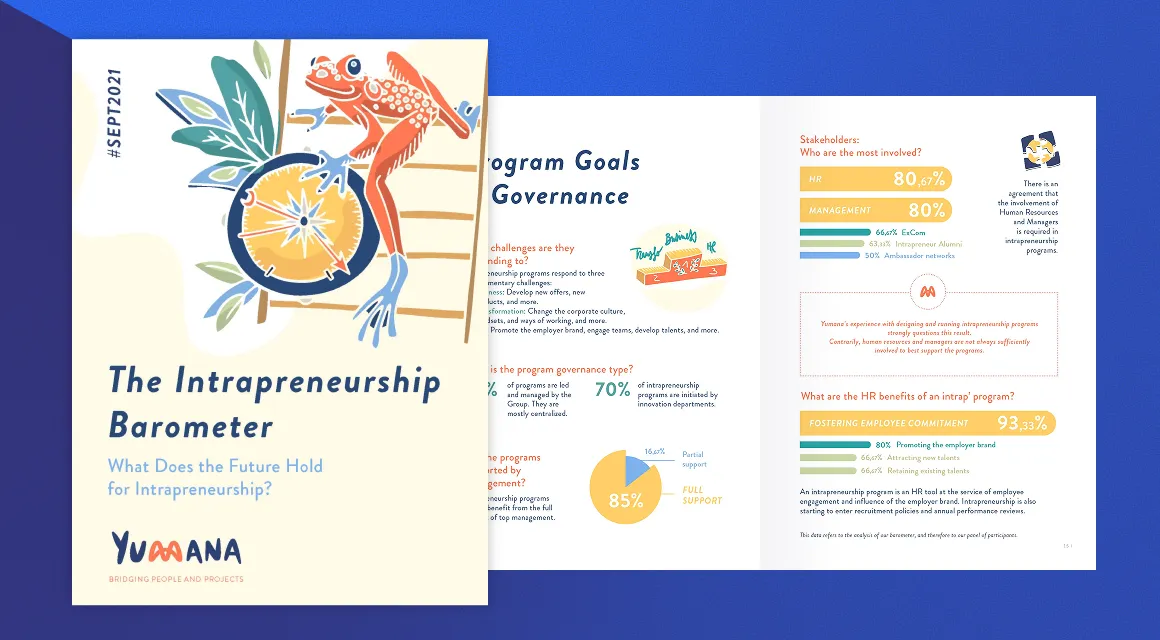
According to Yumana's 2025 Intrapreneurship Barometer, 56% of respondents believe success depends primarily on matching the right idea with the right talent to lead it. Another 38% place the candidate at the heart of the program, while only 6% consider the idea alone to be the central element.
In this context, sourcing is no longer just about collecting ideas. It's about bringing together business potential, the right talent, and a clear path to implementation, within a structured program that can select, test, and develop opportunities into viable projects.
Sourcing therefore becomes more than an initial phase. It's the first step in turning opportunities into projects, and one that needs to be planned from the outset.
Source : Yumana Intrapreneurship Barometer 2025
110 companies surveyed, from 1,500 innovation leaders contacted across Europe.

Sourcing: Ideas, Project Leaders, or Both?
An intrapreneur is more than an employee who contributes ideas. Once selected, they enter a structured program with dedicated time, resources, expertise, and support to test, develop, and pitch their project.
This distinction challenges a common assumption: a promising idea doesn't necessarily have to come with someone ready to lead it.
Companies can take three different approaches:
- Source ideas: Invite employees to identify opportunities, pain points, or problems worth solving, then bring them into the program.
- Source talent: Identify employees with the motivation and capabilities to become intrapreneurs, whether or not they already have a project in mind.
- Separate the two: Select promising ideas and potential project leaders independently, then match them based on their complementary strengths.
This is the approach taken by Siemens and TF1. Both run separate calls for ideas and intrapreneur applications, followed by a matchmaking process to build teams around the selected opportunities.
A jury evaluates ideas and candidates separately before bringing them together in a bootcamp to develop their value propositions.
This way, a promising idea doesn't get left behind simply because its creator doesn't want to lead it. Equally, an employee with strong entrepreneurial potential can take ownership of an opportunity they might never have identified themselves.
Sourcing takes on a different role: ideas and talent become two distinct resources that the program can bring together.
What sets a strong intrapreneurship program apart is its ability to connect the right ideas with the right people and complementary skills.
Selecting Projects: Turning Submissions into Well-Informed Decisions
An idea sourcing campaign can generate a large volume of submissions. But with that comes a new challenge: deciding which projects should move forward.
As applications increase, companies need a clear, consistent framework for identifying the most promising initiatives. Shared evaluation criteria make it possible to compare very different projects without limiting their potential or overlooking what makes each one unique.
With Yumana, ideas can be evaluated against criteria such as business relevance, strategic alignment, technological maturity, market potential, available resources, expected return on investment, and risk level.
These criteria help establish clear expectations and requirements while leaving room for each project's specific characteristics.
Jury, Bootcamp, or Live Pitch: Choosing the Right Selection Format
How should projects be evaluated in practice? The selection format matters. It should help assess how strong each project is while preparing it for the next stage of development.
An application review committee makes it possible to assess a large number of submissions against shared criteria. It supports more in-depth analysis, but naturally tends to favor projects that are already well structured and documented.
A pitch jury adds another dimension: the project leader's ability to communicate their vision, respond to objections, and win over decision-makers. It's particularly useful when companies want selection to become a learning opportunity for intrapreneurs.
A bootcamp brings participants together for an intensive, collaborative experience. It provides an opportunity to see how candidates respond to feedback, work with others, and rapidly develop their projects in real-world conditions.
Some programs take a more immediate approach, combining short pitches, live decisions, and sponsors choosing the projects they want to support.
This matchmaking-style selection process, similar to a talent marketplace, makes it easier to identify promising connections between ideas, project leaders, and future internal sponsors.
Adapting Evaluation Criteria as Projects Progress
Not all evaluation criteria carry the same weight at every stage. Early on, the relevance of the problem, the opportunity's potential, its alignment with business priorities, and the project leader's capabilities may be enough to justify an initial investment.
As projects move forward, the evaluation framework needs to evolve and, where necessary, become more selective to support well-informed decisions.
Moving into incubation or acceleration marks an important milestone. By this stage, a project should be more developed, supported by tangible evidence, and able to attract the resources it needs to progress.
As deployment approaches, other criteria become increasingly important: strong executive sponsorship, a clearly identified project owner, and a business unit ready to take the project forward within its day-to-day operations.
Managing Idea Sourcing and Project Selection at Scale
Centralizing applications, applying consistent evaluation criteria, assigning projects to the right reviewers, consolidating scores, organizing votes, tracking past decisions, identifying similar ideas, and following up on selected or rejected projects…
Selection quickly becomes a complex process to manage.
This is where a dedicated platform provides the structure needed to organize evaluations, support decision-making, and connect projects with the people who can help them move forward.
With Yumana, sponsors can identify the initiatives they want to support directly during the selection process, while project leaders, experts, and stakeholders are connected as projects evolve and require additional resources.
Platform adoption also appears to increase with program maturity: 55% of programs use a dedicated collaborative platform, rising to 65% among those running for more than five years.
What to look for in an intrapreneurship platform
- Centralize applications
- Configure evaluation criteria and weightings
- Coordinate selection committees
- Consolidate scores and votes
- Identify similar projects
- Connect projects with sponsors and experts
- Build project teams
- Keep a record of decisions
A dedicated platform brings the entire sourcing and selection process together. It structures the information collected, supports consistent decision-making, and helps projects move forward by connecting them with the people who can evaluate, support, or redirect them.
The next step is to assess which capabilities a solution actually provides. Yumana’s guide to choosing an intrapreneurship platform brings these features together into five key criteria, with a practical question to ask for each.
The Role of Sponsors: Preparing Projects for Business Adoption
According to Yumana's Intrapreneurship Barometer, sponsorship ranks as the leading success factor for intrapreneurship programs. For a promising idea to move into implementation, it needs to find a home within a business function or business unit.
Having a sponsor means more than securing a favorable vote from a selection committee.
It means finding someone who believes in the project enough to champion it, open the right doors, remove obstacles, and connect it with the resources it needs: expertise, decision-makers, opportunities for experimentation, business stakeholders, and ultimately, a path to deployment.
The sponsor's role becomes particularly important as the project approaches implementation.
They help prepare the business unit to take ownership, facilitate its integration, and address resistance that can arise when an initiative originates outside the team, often referred to as the Not Invented Here (NIH) syndrome.
But effective sponsorship goes beyond recognizing a project's potential and giving it the green light. It's about creating the conditions for its long-term success: helping it find its place within the organization, preparing the next steps, and managing the critical transition from a supported innovation project to an initiative embedded in day-to-day business operations.
Conclusion
Effective sourcing isn't about collecting as many ideas as possible. It's about shaping what comes next. This first stage provides the foundation for the entire program, influencing how opportunities emerge, are challenged and evaluated, move through selection, and connect with their first internal supporters.
A well-designed intrapreneurship platform helps build a more structured and effective sourcing process over time, with each stage strengthening the next. In a successful program, sourcing becomes more than an initial call for ideas. It lays the groundwork for the entire intrapreneurship journey, and that journey needs to be planned from the outset.

CEO & Co-Founder