Blog
5 MINS
Intrapreneurs are central to the success of any intrapreneurship program.
They take ownership of ideas and turn them into projects, making much of the program’s success dependent on their ability to lead, advocate for and move initiatives forward. Giving them the right support means helping both the people and their projects develop.
Coaching, mentoring, training, external consulting support… Companies can combine different approaches depending on their ambitions, objectives and the support they want to provide to project leaders.

Supporting Intrapreneurs Starts with the Right Conditions
Intrapreneurs often have to navigate two roles at once: their regular job and the new responsibility of developing and leading a project. This transition changes how they spend their time, what is expected of them and how they work with others. It needs to be managed carefully if they are to succeed.
HR teams and managers should be involved as early as possible to clarify how much time is genuinely freed up, what is expected, and the framework within which intrapreneurs will carry out their assignments.
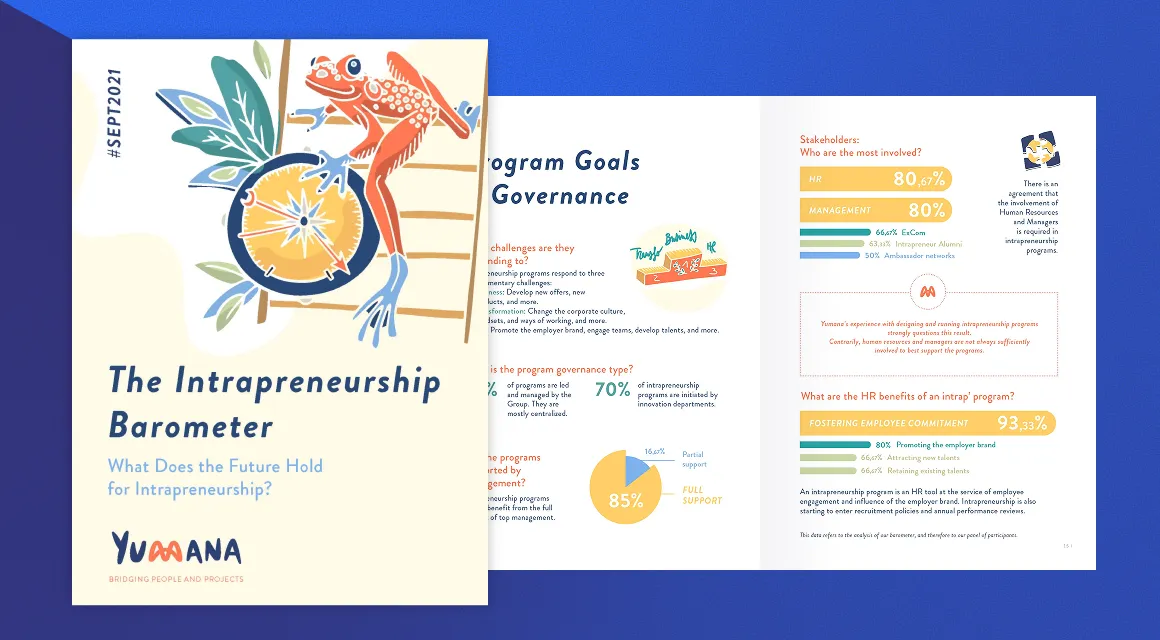
Yumana's Intrapreneurship Barometer shows that intrapreneurs spend nearly half their working time on their projects, on average. A formal framework helps make that commitment possible, but it is only part of the equation. Unlike entrepreneurs working independently, intrapreneurs can also draw on their organization’s expertise, business units, mentors, sponsors and resources.
Intrapreneurship gives project leaders an opportunity to develop new skills and grow professionally. For companies, the challenge is to give them room to take initiative while ensuring that the skills gained can lead to meaningful career opportunities.
There is no single way to support every intrapreneur. Companies can bring together different forms of support based on the needs of project leaders and the level of assistance they want to provide.
5 Ways to Support Intrapreneurs at Every Stage
The right support depends on a project’s maturity, where it stands in the program and the type of journey involved. An intrapreneur going through incubation, for example, will not have the same needs as someone working on venture clienting, acceleration or scaling.
The challenge is to make the right support available when it will be most useful to both the project and its leader. Coaching, mentoring, specialist expertise, training, peer learning, sponsorship and access to dedicated resources can each make a difference at different stages.
External coaching and expertise
External experts provide hands-on support as projects develop. They help intrapreneurs refine their value proposition and business model, conduct market research, design experiments and prepare pitches.
Their value lies in bringing structured methods and specialist expertise to help build stronger, more viable projects.
Internal mentoring
An internal mentor knows how the company works: its business units, decision-making processes and, often, the shortcuts that help things move forward. They give intrapreneurs the context they need to navigate an organization they know as employees but may see differently when leading a project.
Mentors can help identify what is holding a project back, point intrapreneurs toward the right experts and explain how decisions are made. They also make introductions and build connections across the business. In a large organization, knowing who to speak to can be just as important as knowing what to do next.
Sponsorship
Mentors offer guidance; sponsors help projects gain traction. They raise an initiative’s visibility across business units, bring decision-makers on board, facilitate decisions and advocate for the time, resources or business-unit support it needs.
Their role becomes especially important when a project is approaching a funding or deployment decision.
Training
Training turns the intrapreneurship journey into an opportunity to build new capabilities. As projects develop, intrapreneurs may need skills in entrepreneurial methods, finance, marketing, experimentation, influencing, pitching and project management.
These skills remain valuable to employees well beyond the project itself.
Peer learning
Current and former intrapreneurs can learn a great deal from one another. Sharing experiences, discussing challenges, exchanging contacts and passing on best practices help project leaders find solutions and feel less isolated in their new role.
Over time, this dynamic can extend into a community of alumni, mentors, and former project leaders.
Together, these approaches create a support network around intrapreneurs. Some help projects progress; others focus on people’s development. The greatest value comes from combining both, while encouraging a culture of initiative, experimentation and collaboration.
Training Intrapreneurs and Recognizing the Skills They Develop
According to Yumana’s 2025 Intrapreneurship Barometer, 94% of companies see intrapreneurship as a way to develop employee skills. Yet only 4% offer certification at the end of the assignment.
This creates a gap between the skills employees gain and the recognition they receive. When that learning is not formally documented, it can be overlooked once the program ends rather than contributing to future career development.
HR teams therefore have two responsibilities: help intrapreneurs develop their skills throughout the program and make those skills visible afterwards.
Certifications, badges, competency frameworks, talent reviews, development plans, internal mobility, new responsibilities and dedicated qualifications can all play a part.
- Recognize: Use internal badges or certifications to acknowledge the skills employees have put into practice during the program.
- Certify: Formal recognition may take the form of a certificate, an accredited set of competencies or a qualification developed with an external institution. Michelin, for example, co-developed a dedicated intrapreneurship certificate with Clermont School of Business. Participants work on real projects, produce a deliverable and defend their projects before a panel. The certificate validates competencies that can count toward a Level 7 Executive MBA qualification.
- Leverage: Bring these newly acquired skills into competency frameworks, talent reviews, internal mobility programs and professional development plans.
For HR teams, making the skills gained through intrapreneurship visible and reusable helps fully integrate the program into the company's talent management strategy and extend its benefits well beyond the program itself: employee retention, internal mobility, skills development, and career progression.
Source : Yumana Intrapreneurship Barometer 2025
110 companies surveyed, from 1,500 innovation leaders contacted across Europe.
Scale Support Without Losing the Personal Touch
As an intrapreneurship program grows, it may involve more cohorts, more projects and a wider range of needs and maturity levels. The challenge is to tailor each journey without making the program harder to manage, and to simplify processes without forcing every project into the same model.
A dedicated digital platform can help coordinate these different journeys within one shared framework. It makes it easier to provide relevant resources at the right time, connect intrapreneurs with experts, identify and mobilize the skills each project needs, and track progress without creating unnecessary parallel processes.
Yumana enables organizations to build tailored journeys around each project’s stage, provide training and coaching suited to different levels of maturity, centralize resources, and connect intrapreneurs with relevant mentors, sponsors and experts.
At Safran, the We Love Intrapreneurs program, run with Yumana, takes employees from ideation and team formation through intensive bootcamps and incubation phases that can last several years. More than 150 employees have been trained in new business development methods, over 40 projects have been incubated, and eight have received acceleration support toward industrialization.
Now deployed across around ten Safran Group companies, the program shows how intrapreneurship can develop project leaders’ skills while gradually introducing new ways of working across the organization.

CEO & Co-Founder