Guide
13 MINS
Most intrapreneurship programs that come to an end don’t fail because they miss their targets. In fact, unmet objectives account for just 9% of program closures, which occur after an average of three and a half years.
Organizational and structural obstacles are far more common. Companies have become good at inviting employees to share ideas. The harder part is creating the conditions for those ideas to make it all the way into the business.
That is what separates an engaging initiative from an intrapreneurship program that delivers lasting value: the right program design, clear commitments from the outset, a way to move projects forward and a credible approach to measuring impact.
This guide walks through the full journey, from launch and employee engagement to project delivery and long-term program management.
What Is an Intrapreneurship Program?
From intrapreneurs to a structured program
An intrapreneurship program gives employees the opportunity to develop and lead new ventures or innovation projects within their company. It provides a structured framework, dedicated time, funding and support to explore opportunities that align with the organization’s priorities, whether that means new products and services, use cases, business models or sources of growth.
Where an ideation campaign helps uncover ideas, an intrapreneurship program also identifies the people ready to take them forward. Employees move from contributing suggestions to taking ownership of projects, with access to the expertise, resources and support they need to test an opportunity and turn it into something the business can use.
That shift from contributor to project leader is at the heart of intrapreneurship.
Intrapreneurship, employee-driven innovation and corporate venturing: what’s the difference?
Employee-driven innovation brings more people into the innovation process and intrapreneurship concentrates time and resources on those who will lead a project. The two can work together or independently. Corporate venturing has a different end goal: building a new business.
When does a company need an intrapreneurship program?
Often, the trigger is organizational. Established business processes aren’t always designed to explore uncertain opportunities, test early assumptions or give emerging projects room to develop.
An intrapreneurship program creates that space, with a clear mandate, accountable project leaders and dedicated funding. Teams can experiment without losing their connection to the wider organization, making a future handover or scale-up more realistic.
It may not be the best place to start, however. A company that has never run an ideation challenge or built a culture of collaborative innovation may need to develop those capabilities before introducing a more demanding intrapreneurship model.
Why Launch an Intrapreneurship Program? 4 Benefits You Can Measure
Intrapreneurship helps companies pursue business opportunities while giving employees new ways to learn, collaborate and take initiative. Its value is both commercial and organizational, and both sides deserve to be measured.
Find new growth opportunities beyond the core business
Day-to-day priorities can make it difficult to give unfamiliar opportunities the attention they deserve. Intrapreneurship gives teams the freedom to explore them on a manageable scale, drawing on the company’s customers, data, assets and expertise before larger investments are made.
This combination matters: projects have space to venture beyond the core business while retaining the advantages of being part of an established organization.
The evidence of success comes from what happens next: validated business cases, projects adopted by business units, products brought to market, new revenue streams or entirely new businesses.
Attract and retain high-potential employees
Leading an intrapreneurial project offers a kind of professional experience that employees may struggle to find in their usual role. They gain autonomy, make decisions and build entrepreneurial skills without leaving the organization. That can strengthen retention, open up new career paths and make the company more attractive to ambitious talent.
Retention rates, internal mobility and employer-brand indicators can help show whether those benefits are materializing.
Build a stronger culture of innovation
The influence of an intrapreneurship program reaches beyond the people selected to lead projects. Managers, mentors, subject-matter experts and executive sponsors all encounter new approaches to experimentation and cross-functional collaboration. Over time, those practices can spread to teams and projects outside the program.
Useful indicators include the number of employees trained, the range of functions involved, the use of these approaches elsewhere in the business and wider employee engagement.
Bring promising projects to market faster
When teams have protected time and a more direct route to decisions, they can test assumptions sooner and progress without being held back by standard corporate timelines. Time-to-market becomes a meaningful measure: how long does it take to move from selection to prototype, from experiment to investment decision and, ultimately, from validation to launch?
The numbers behind intrapreneurship
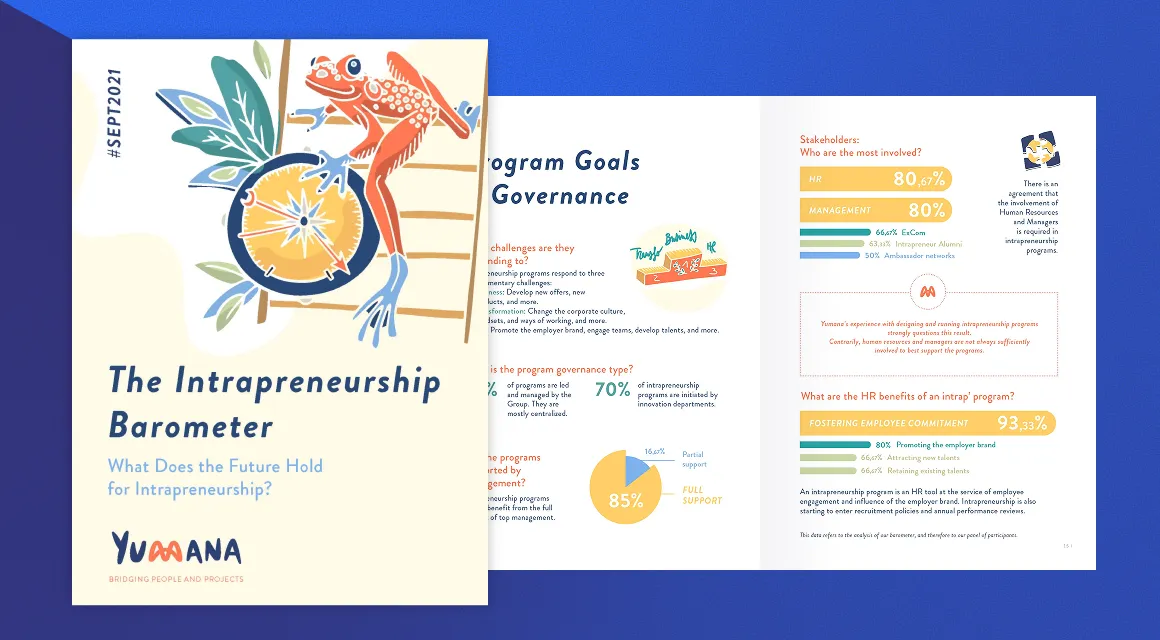
Intrapreneurship is now expected to contribute as much to people’s development and organizational change as it does to business performance.
Source: Yumana Intrapreneurship Barometer 2025.
Based on responses from 110 companies, among 1,500 innovation leaders contacted across Europe.
4 Ways to Structure an Intrapreneurship Program
There is no single intrapreneurship model. The right format depends on how mature the projects are, how much responsibility employees will take on and how far the company wants to go. Some programs move through several formats in sequence; others combine them to create a journey from opportunity discovery to business launch.
Internal incubator
An internal incubator gives early-stage projects time to take shape. Over several months, intrapreneurs refine their value proposition, test assumptions with real users, explore business models and establish whether an opportunity is viable.
It is particularly useful for companies that want intrapreneurship to become an ongoing capability, with an environment where project leaders can learn, test and build over time.
Intrapreneurship accelerator or sprint
Accelerators are designed for projects that have already been identified and developed enough to benefit from focused, intensive support. The aim is to reach a specific milestone or decision within a defined period.
A sprint applies the same principle in a shorter, more concentrated format. Both are well suited to organizations with an existing pipeline of projects that need to validate market demand, test critical assumptions and decide which opportunities warrant further investment.
Internal innovation challenge
An innovation challenge often serves as the entry point to a larger program. By inviting employees to respond to a specific business problem or strategic priority, the company can surface a wide range of ideas, build its opportunity pipeline and identify potential project leaders.
The challenge itself is only the beginning. Promising ideas need a more structured next phase if they are to become viable projects.
Corporate venture builder
A corporate venture builder is intended for opportunities with the potential to become new businesses. These projects may sit too far outside the core business, span multiple divisions or lack a natural home within an existing business unit.
Rather than trying to fit an unfamiliar opportunity into the current organization, a venture builder gives it a dedicated team, structure and resources to establish an independent business. This approach is particularly relevant when a more entrepreneurial operating model is needed to unlock a meaningful new source of growth.
How to choose the right approach
Four questions should guide the decision: How far along are the projects? What does the business ultimately want them to become? What level of funding and support can it provide? And how quickly does it need results?
As project maturity and ambition increase, so do the need for dedicated resources, intensive support and decision-making autonomy.
Further reading: How to choose and combine the different formats within an intrapreneurship program.
How to Launch an Intrapreneurship Program in 8 Steps
A successful program needs a clear path from initial design to project deployment.
These eight steps provide a practical framework.

How to Keep Your Program Running and Delivering Value
Demo day is a milestone, not the finish line. The longer-term challenge is to keep the community engaged, ensure promising projects find a home in the business and build a program that can survive changes in leadership, budgets and priorities.
Four areas deserve particular attention.
Put governance in place: who decides, and when?
Strong governance depends on knowing who is responsible for what. Alongside the executive sponsor, identify the program team, the business units involved and the people responsible for key decisions, then agree on the milestones and review schedule.
A steering committee should meet regularly to review progress, allocate resources and decide whether projects are ready to move ahead. The right people around the table, meeting at a consistent cadence, can make a significant difference to the momentum of each cohort.
Keep the intrapreneur community active between cohorts
A community of current intrapreneurs and alumni is an asset worth nurturing. Sharing lessons learned, introducing people across teams, showcasing projects and celebrating participants’ achievements help sustain engagement between calls for applications and incubation cycles.
People who have already been through the program are especially valuable. They make the opportunity more credible to future participants and can serve as mentors, advisers or internal ambassadors. By connecting past and present cohorts, the program develops a community that continues to contribute even when no new projects are being selected.
Make sure projects have a future beyond demo day
One of the biggest obstacles to implementation is the absence of a clear operational owner. The handover needs to be prepared while a project is still in incubation, with a committed business sponsor, an identified owner, a realistic budget and agreement on how the receiving team will take it forward.
Planning early reduces the likelihood of stalled decisions, funding gaps, unclear accountability or the familiar “not invented here” response. It gives every project selected for deployment somewhere concrete to land.
Make the program a lasting organizational capability
Programs are often discontinued because the arrangements behind them were too temporary: a sponsor changes roles, a budget comes up for renewal, a team is reassigned or there is no plan for what happens after the first cohort.
Long-term success depends on treating intrapreneurship as a capability the organization continues to develop. Each cohort produces insights, successes and setbacks that can strengthen the next. Making that value visible also requires a deliberate effort: share business outcomes, tell the stories of intrapreneurs’ career paths, show which projects business units have adopted and explain what the organization has learned.
Further reading: How to demonstrate the full value of an intrapreneurship program.
Measuring ROI: The KPIs That Matter
Only 39% of companies set measurable objectives for their intrapreneurship programs. Yet a meaningful assessment needs to go beyond project counts to consider four dimensions together: employee engagement, the progress of ideas into viable projects, the business value generated and the impact on talent and organizational culture.
Employee engagement metrics
Participation rates, activity around projects, the number and variety of departments involved, and manager engagement all help reveal where the program is gaining traction.
They also show which employee groups are underrepresented and where stronger communication or community engagement may be needed.
Project activity and progression metrics
A program’s job is to help opportunities move forward. Track conversion rates from one stage to the next, time to prototype or minimum viable product (MVP), the pace of project development and the number of projects ultimately taken on by a business unit.
The rate at which projects are stopped matters, too. Ending an initiative when the evidence no longer supports it can be a sign of a healthy decision-making process, rather than failure.
Business value metrics
As projects mature, results become more tangible: new revenue, cost savings, customer acquisition and shorter time-to-market. For earlier-stage projects, market traction and the strength of the business case provide evidence of potential before financial returns are visible.
One particularly telling metric is the number of projects successfully adopted by business units. It shows which innovations have found a sustainable place in the organization, beyond simply reaching launch.
Talent and innovation culture metrics
Intrapreneurship can have effects that last well beyond the projects themselves. Participant satisfaction, new skills, internal mobility, career progression, retention, managerial involvement and wider adoption of innovation practices all help capture that impact.
Employee Net Promoter Score (eNPS) can provide a useful indication of whether participants would recommend the experience. Follow-up on the careers of former intrapreneurs adds another perspective on what the program has contributed to employees and the business.
Not every metric will matter equally at every stage. Some show how actively people are taking part; others reveal whether projects are progressing, value is emerging and new capabilities are taking root.
Further reading: 12 KPIs for measuring and improving your intrapreneurship program.
5 Mistakes That Can Undermine Your Program
1. Leaving HR out of the design process
Intrapreneurship changes an employee’s working arrangements. It affects how much time they spend on their usual role, their relationship with their manager, potential temporary assignments, recognition of new skills and what happens when they return. HR needs to help establish the rules from the beginning, ideally through a shared policy rather than a series of individual exceptions.
Without a consistent framework, arrangements can become difficult to manage, particularly for middle managers who are expected to deliver with fewer resources while employees work on their projects.
HR also has an important role after the program. Intrapreneurship can open doors to internal mobility, new responsibilities, career progression and mentoring opportunities. Recognizing those outcomes helps retain talent and gives the organization a pool of experienced people who can contribute to future cohorts.
2. Expecting intrapreneurs to do two jobs at once
A project quickly becomes unsustainable when it is added on top of a full-time role. Intrapreneurs need formal arrangements that genuinely free up the time required to experiment, build and move their projects forward. Protected time has to work in practice, not just on paper.
3. Promising disruptive innovation without funding it
Putting the word “disruptive” in a call for projects won’t make a program disruptive. The further a company wants teams to explore beyond its existing business, the more willing it must be to provide time, funding, specialist knowledge and room to experiment.
A mismatch between bold ambitions and limited resources creates frustration and can ultimately put the whole program at risk.
4. Launching without a ring-fenced seed budget
Incubation costs money before a project is ready to attract its next round of funding. A dedicated seed budget should cover experiments, prototypes, coaching, specialist support and early customer or market tests.
That initial funding allows teams to build the evidence needed to justify further investment. Once a project’s value has been demonstrated, a business unit, corporate function or another funding source can take over.
5. Starting measurement too late, or demanding ROI too early
Application numbers and participation rates show interest, but tell only part of the story. Define objectives and indicators at launch so that the program can demonstrate progress, identify improvements and make a stronger case for future investment.
At the same time, give it a realistic horizon. A program typically needs three to four years to show its full value, especially when the projects challenge the core business. Expecting an immediate financial return from the first cohorts can bring a promising initiative to an end before its benefits have had time to materialize.
Intrapreneurship in Practice: 4 Company Examples
Most intrapreneurship programs rely on similar building blocks. What makes each program unique is how these elements are combined and adapted to fit an organization's culture, ambitions and ways of working.
Explore key lessons from successful intrapreneurship programs at leading companies.
LVMH: Combining digital ideation with a live bootcamp
At LVMH, a digital ideation phase leads into a three-day, in-person bootcamp where teams develop and challenge 60 shortlisted ideas. Twelve projects then pitch to a jury, and three are selected to continue into incubation with an executive sponsor.
The platform helps surface the initial opportunities; the bootcamp creates a shared moment for testing the strongest ideas and discovering the people ready to lead them. Since launch, more than 100 projects have been incubated. The latest edition involved over 24,000 employees and generated more than 3,800 ideas.
TF1: Matching ideas with the right people
TF1 separates the call for ideas from the call for intrapreneur applications. Employees can suggest an opportunity without volunteering to lead it, while others can apply to become project leaders without having submitted an idea of their own.
The company then matches promising concepts with people who have the skills and motivation to develop them. Its third edition attracted more than 800 active users, with 30% of submitted ideas in the process of being implemented.
Safran: An end-to-end intrapreneurship journey
Safran’s We Love Intrapreneurs program takes employees from idea submission and community voting through three residential bootcamps, followed by incubation that can last up to three years for sponsored projects.
After six years, the platform has more than 3,000 active users. Seven projects now make it to bootcamp each year, and the model has expanded to 10 Safran Group companies.
Air France: Making it easy to take part
With Boost the Future, Air France has made accessibility a priority across three editions. Employees apply by answering just three questions. The program then brings teams together through skills-based matching, invites them to pitch to the employee community, draws on expert evaluations and uses virtual crowdfunding-style voting to select projects.
Each edition has attracted approximately 6,000 users, with around 600 ideas submitted annually and eight concepts selected for incubation in each cycle.
Frequently Asked Questions
How much does an intrapreneurship program cost?
Costs vary according to the number of cohorts, how much working time participants are given, the level of coaching and specialist support, the resources allocated to projects and the platform used to manage the program.
There is no meaningful one-size-fits-all budget. The largest costs are usually the people and resources committed to the program and its selected projects. It is therefore more useful to budget by cohort than to think of intrapreneurship as a one-off event.
How much time should employees spend on their intrapreneurship projects?
It depends on the program’s ambition and the stage each project has reached. The allocation may change as a project develops. What matters is that this time is taken out of an employee’s normal workload, rather than added to it.
What’s the difference between an intrapreneurship program and a hackathon?
A hackathon is a short, intensive event designed to generate ideas or prototypes quickly. An intrapreneurship program provides a longer-term framework in which employees can test, develop and potentially deploy projects.
The two can work well together. A hackathon can be an important early milestone within a broader intrapreneurship journey.
Do you need a dedicated intrapreneurship platform?
For a very small program, perhaps not. But as participation and the number of projects grow, a dedicated solution becomes increasingly useful for managing idea submissions, voting, scoring, team formation and the overall project portfolio.
Yumana’s Intrapreneurship Barometer found that 55% of programs use a dedicated platform, rising to 65% among programs more than five years old.
Capabilities vary significantly. Beyond collecting ideas, look at whether a platform can support projects through their lifecycle, manage program stages, connect employees with relevant expertise, structure evaluations and decision-making, and track the value created.
Further reading: How to choose an intrapreneurship platform.
How are intrapreneurs compensated?
In most programs, employees keep their regular salary while part of their working time is formally allocated to the project. Additional financial incentives are less common, but recognition can also come through bonuses, career opportunities or greater visibility within the business.
What happens to projects that aren’t selected?
An idea may be dropped if testing doesn’t establish its potential. But not every project that misses out on the program has to end there. Some can enter a business unit’s project pipeline, contribute to an existing initiative or be refined for a future cohort.
What matters is giving each team a clear decision and capturing what has been learned. That helps protect employee engagement and build confidence in the selection process.
How large does a company need to be to run an intrapreneurship program?
Intrapreneurship isn’t reserved for large corporations, although the potential reach is greater when more employees can get involved. Larger organizations generally benefit from more formal structures, while smaller businesses can adopt a lighter, more flexible approach.
How long does it take to see results?
Early signs of progress, such as strong applications, selected projects, customer validation or prototypes, should emerge relatively quickly. Business results take longer because projects need time to complete incubation and find a route to deployment.
Over the longer term, assess success by looking at how many projects are implemented, whether the program can support successive cohorts and how it shapes the company’s innovation culture.


CEO & Co-Founder