Blog
5 MINS
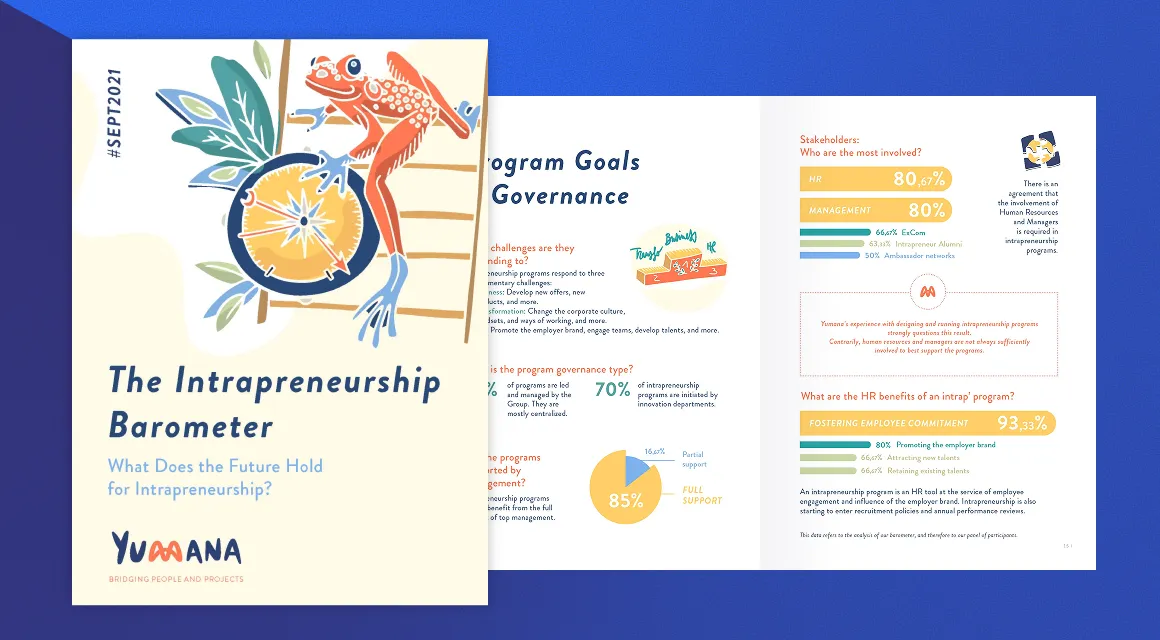
94% of companies surveyed by Yumana see intrapreneurship as a way to develop employee skills, yet only 4% offer formal certification at the end of the program.
This gap reveals a missed opportunity. While intrapreneurship programs clearly contribute to talent development, the skills and capabilities they help build are still too rarely identified, recognized, or put to use across the organization.
And skills development is only part of the picture. The benefits of intrapreneurship extend far beyond upskilling.
For HR teams, the challenge is to recognize the talent value created through intrapreneurship and translate it into meaningful career opportunities, internal mobility, and organizational development.
This is what makes intrapreneurship a valuable part of an HR strategy: not just during the program, but before it begins and, above all, after it ends.
Source : Yumana Intrapreneurship Barometer 2025
110 companies surveyed, from 1,500 innovation leaders contacted across Europe.

Uncover the Skills Your Organization Will Need Tomorrow
High-potential employees aren't always easy to identify through traditional HR processes. Some capabilities only truly emerge when people step outside their usual roles: influencing others without formal authority, learning quickly, iterating, and navigating uncertainty.
The rapid rise of AI makes these skills even more valuable as execution becomes increasingly standardized.
Creativity, critical thinking, complex problem-solving, leadership, empathy, adaptability, continuous learning, and social influence are becoming key differentiators in what employees bring to an organization.
Intrapreneurship puts these capabilities to the test.
Leading a project means stepping beyond day-to-day responsibilities, building connections across the organization, drawing on expertise, securing support from sponsors, responding to objections, testing assumptions in real-world conditions, and bringing people together without necessarily having formal authority.
Intrapreneurship therefore provides a valuable opportunity to identify and observe capabilities that organizations will increasingly need to recognize.
Turn the Intrapreneurship Experience into a Shared HR Asset
For HR teams, the value of intrapreneurship extends well beyond the employees leading projects. Contributors, experts, managers, business units, mentors, and sponsors are also involved, gaining exposure to different ways of working.
The program becomes a learning opportunity for a much wider community than the intrapreneurs themselves.
Beyond developing individual project leaders, organizations strengthen their collaborative practices, build on continuous learning, and gradually foster a culture that encourages initiative, experimentation, and collective intelligence.
A dedicated platform plays an important role in bringing employees together around projects while building a shared pool of skills and expertise. It helps identify capabilities that may be scattered across the organization and connect people beyond traditional silos and reporting lines.
With Yumana's Team Matching capabilities, project leaders can connect with employees whose skills complement their own and build effective teams.
This becomes increasingly valuable as organizations move toward identifying and mobilizing talent based on skills and capabilities, rather than job titles alone.
Turn the Intrapreneurship Experience into Career Opportunities That Retain Talent
Becoming a manager isn't necessarily every high-potential employee's ambition. Many are looking for greater autonomy, more responsibility, and opportunities to learn and build something new.
Intrapreneurship gives employees with an entrepreneurial mindset a way to pursue these ambitions without leaving the company. It also opens up opportunities for career development that go beyond traditional promotions.
But what happens after the program matters just as much. When employees return to exactly the same role and responsibilities, the experience can lead to frustration, and the organization risks losing the value of the skills they've developed along the way.
Yumana's Intrapreneurship Barometer shows that only 52% of companies support employees as they return to a role after completing their projects. This rises to 65% among programs running for more than five years.
The lesson is clear: as programs mature, planning what happens afterwards becomes an integral part of the strategy.
Career development opportunities are also more common in established programs, reaching 53% among those running for at least three years, compared with 49% overall.
The experience can also help build a lasting talent community. Alumni from each cohort can become mentors, jury members, ambassadors, support future cohorts, or return to lead new projects themselves.
The Role of HR: Set the Framework, Provide Support, and Build on the Experience
An employee's role and working arrangements are central to the intrapreneurship experience. Part of their working time shifts toward the project, their manager must adapt to reduced availability, and the experience may eventually lead to a change in their role.
All of this needs to be addressed from the outset.
BEFORE: establish a clear framework
HR teams help define the ground rules: dedicated project time, potential temporary assignments, how project responsibilities fit alongside day-to-day work, the manager's role, return-to-work arrangements, and how the experience will be recognized.
Time allocation is a critical HR consideration: intrapreneurs dedicate an average of 46% of their working time to their projects, rising to 56% in programs running for more than five years (source: Yumana Intrapreneurship Barometer).
That's close to half an employee's working week, and it requires proper planning.
A shared policy helps prevent the program from relying on a series of individual arrangements that can quickly become difficult to sustain when business units temporarily lose part of an employee's availability.
Direct managers also need to be involved from the beginning. They must manage reduced capacity within their teams and have a clear understanding of the program's duration, the resources committed, and the conditions for employees' return.
HR needs to address these questions before the program begins.
DURING : support employees and managers
Throughout the journey, HR ensures that the experience remains manageable for both intrapreneurs and their teams. This means supporting managers, tracking emerging skills, and helping recognize learning and development that extend beyond the project itself.
Supporting intrapreneurs is a challenge in its own right. Coaching, mentoring, executive sponsorship, training, and peer learning serve different purposes and become valuable at different stages of the journey.
AFTER : recognize skills and build on the experience
What happens to a project leader when their project moves forward? And when it comes to an end? How should newly acquired skills be recognized? What new assignments, internal mobility opportunities, or responsibilities could build on what the employee has demonstrated?
Returning to a previous role, moving internally, taking on a new assignment, progressing professionally, or receiving formal recognition for acquired skills are all important outcomes to consider.
Ultimately, HR is more than a partner in an intrapreneurship program. It ensures that the experience fits within the organization's broader approach to work, management, and career development.
Measuring the HR Value of Your Intrapreneurship Program
The HR value of an intrapreneurship program can be measured across several dimensions, each revealing how the experience creates lasting change within the organization
The most revealing insights often emerge several months after the program ends: what have the intrapreneurs gone on to do? Combined with business performance metrics, these indicators help capture the value intrapreneurship creates not only for projects, but also for employees and the wider organization.
Turn the Intrapreneurship Experience into Proof of Your Employer Brand
Autonomy, impact, initiative, and opportunities to step beyond traditional job descriptions are now common employer brand promises. An intrapreneurship program provides tangible proof that these opportunities actually exist.
Employees given dedicated time and resources, career paths that evolve after the program, alumni who become mentors, and projects that bring different business functions together all provide concrete examples of this promise in action, both internally and externally.
Employee testimonials, profiles, post-program career stories, and employee advocacy help companies showcase what their employees have actually experienced, rather than simply what they claim to offer.
Among the companies surveyed by Yumana that had never launched an intrapreneurship program, one in two believed it could help attract new talent.
Intrapreneurship therefore brings an employer brand promise to life by demonstrating that the company gives its people the space to build new ventures, make an impact, and grow professionally.
Conclusion
An intrapreneurship program creates business value, but its impact on HR goes much further.
It reveals skills that are difficult to identify through traditional processes, builds new connections, opens up career opportunities, and introduces different ways of working across the organization.
By identifying, recognizing, and putting these capabilities to work, HR can turn an experience led by a small group of intrapreneurs into a shared organizational asset that benefits employees, the wider business, and ultimately, the employer brand.

CEO & Co-Founder